The Aegean Supply War
– A ww2stories.org Exclusive –
As the war closed in on the Nazis in mid-1944, an aerial Amada of 71 Allied planes set off to ‘prang’ a German convoy desperately trying to resupply the Greek island of Crete. Ross J. Robertson with Dimitri Galon and Dr Konstantinos Giannakos investigate the story and its impact on the Aegean Supply War.
It is June 1st, 1944. With the thunder of bombs still echoing in the air and thick plumes of smoke rising into the sky, the Allies’ first wave has already torn into the Gertrud convoy. German vessels are battered, vulnerable, and scrambling to evade further destruction. But any hope of relief is fleeting. As the bombers retreat toward their base, the deadly roar of Allied Beaufighters fills the air. These relentless predators, armed with rockets and cannons, are closing in fast, racing toward their targets just above the waves.
In Part II of this gripping two-part series, the convoy’s desperate attempts to scatter become futile as the Beaufighters prepare to unleash their final, devastating assault. The battle reaches its fever pitch, and escape seems all but impossible. The convoy’s ultimate fate now hinges on a razor’s edge.
BEAUFIGHTER HAVOC
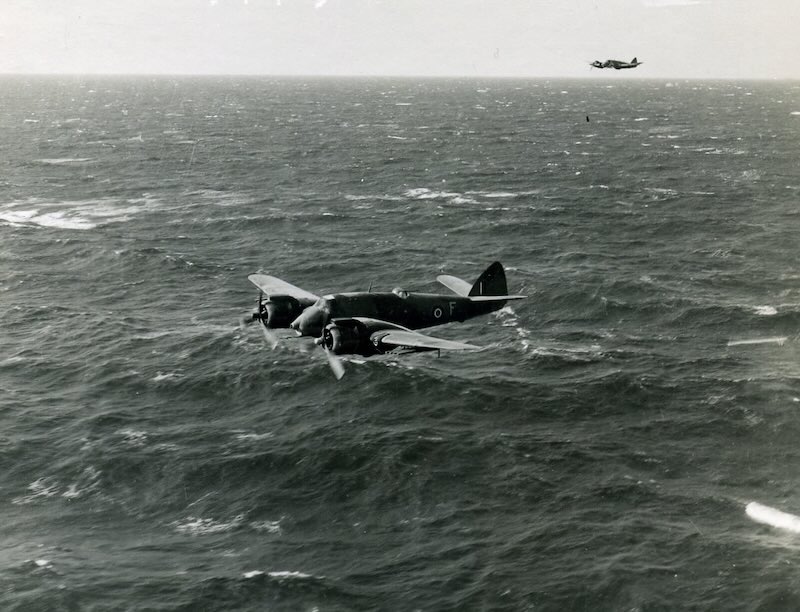
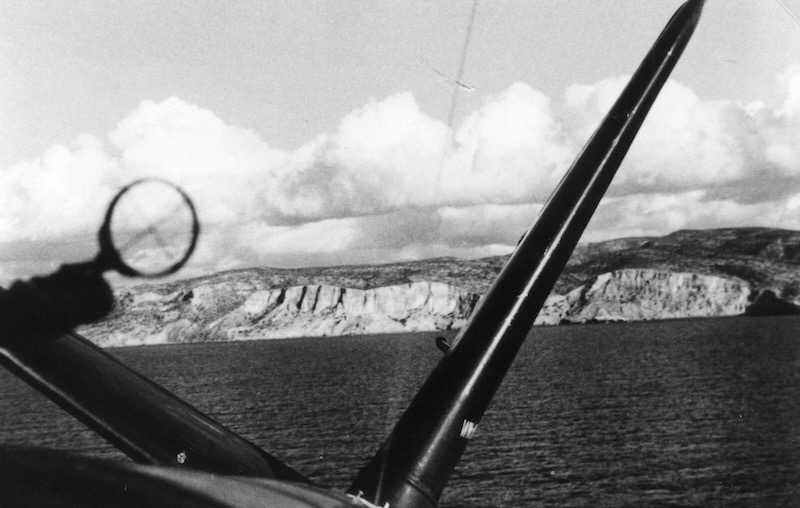
At 19:05 hrs, they came in very low and very fast from the west, taking full advantage of the sun behind them. Led by Wg Cdr Meharg of 252 Squadron, the Beaufighters soon encountered a deadly wall of intense flak. UJ-2101 found itself in the direct line of approach in what Oblt Brinckmann assumed to be a torpedo attack. Fighting for their lives, the gun crews of both 8.8 cm flak and rocket shell projectiles opened fire as soon as the invaders reached the 6,000 m periphery. At 4,500 m, all anti-aircraft weapons were trained on the approaching aircraft. Although scattered and therefore less effective than they would otherwise be, the other vessels – including the armed merchantmen themselves – were also firing “at the highest rate of fire attainable,” in an attempt to effect a kill zone. 1 2 3
The approaching line of Beaufighters then split into three groups for a broadside attack. According to Oblt Brinckmann, this was probably to avoid the barrage balloons. 4 However, the Beaufighters had been previously arranged into a central strike force with two flank formations. 5 6
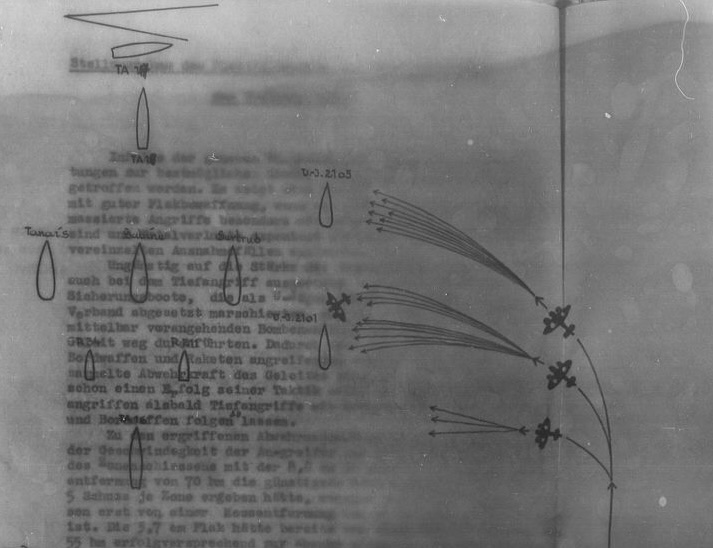
Image © Dimitri Galon.
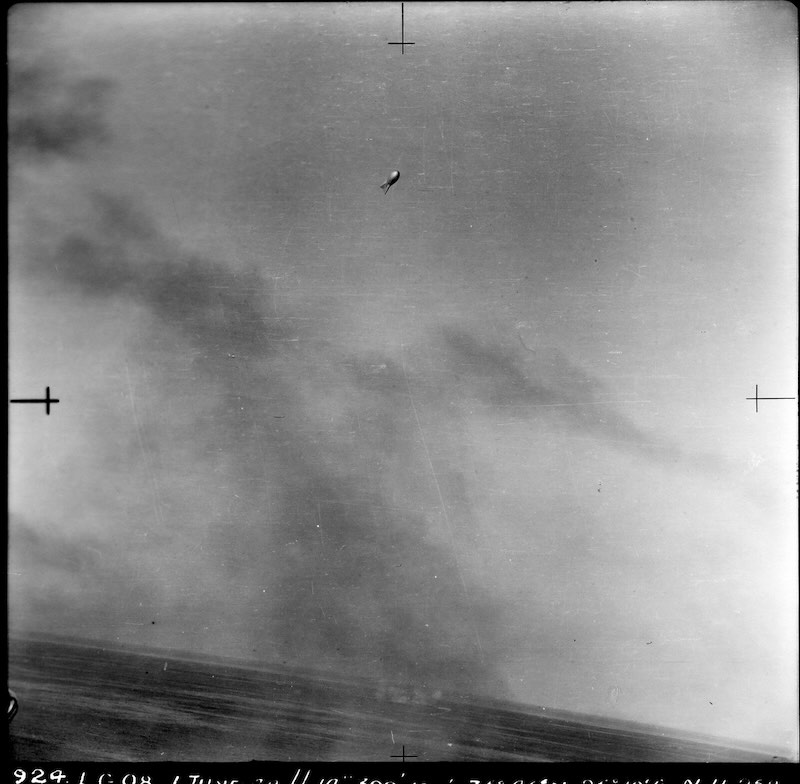
Tasked with flak suppression within 252 Squadron, the Beaufighters of WO Bates (aircraft ‘J’) and WO Stevenson (aircraft ‘R’) went in first at masthead height, braving the intense flak, rocket shell projectiles with their trailing wires, and the steel cable tethers of the barrage balloons flying at 2,000 ft. 7 They went after a large torpedo boat at the rear of the convoy. WO Bates fired a salvo of six 25 lb RPs, WO Stevenson let loose with his four .787 in (20 mm) cannon while firing another eight 25 lb rockets. The high explosive cannon shells were seen to score hits, but as the pilots broke away, the effects of the rocket attack were unobserved in the confusion of flame, smoke and defensive flak fire below. Sqn Ldr Butler in aircraft ‘B’ struck the Sabine with a full salvo of eight 60 lb rockets, causing destruction on-board and clouds of billowing smoke. The Sabine was hit again, even as it headed on a reciprocal course, this time by Plt Off Pierce in aircraft ‘D’, who fired another salvo of eight 60 lb rockets, scoring a direct hit on the stern which immediately erupted in a fireball of flame, smoke and debris. According to Squadron records, the stern “seemed to be blown off completely.” The Tanais was then hit along its deck line by eight 60 lb rockets from Fg Off Tuffin’s aircraft, creating an inferno and producing a huge cloud of smoke or steam. WO Jones in aircraft ‘A’ came roaring in, firing two 60 lb rockets at another of the torpedo boats and two more at the Tanais in rapid succession. The torpedo boat began belching smoke. Both Fg Off MacIntosh in aircraft ‘E’ and WO Legat in aircraft ‘X’ fired salvos of 60 lb rockets at the Sabine, but they either overshot or undershot. Fg Off MacIntosh also fired on an Arado 196, peppering it with machine gun fire. As reported in the archives, another Arado “was seen minus its floats, and a third with its floats on fire.” 8
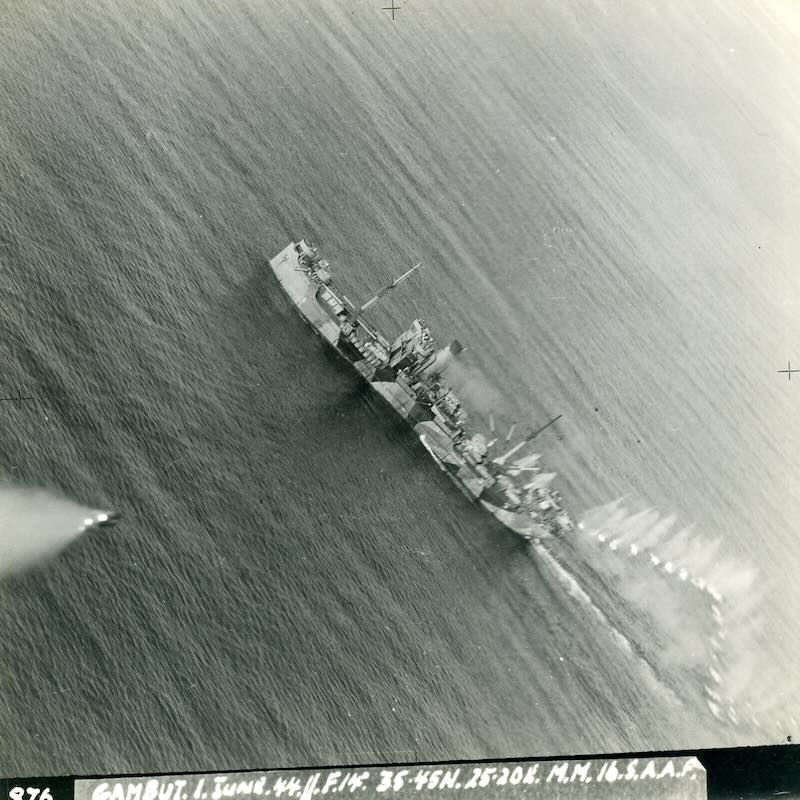
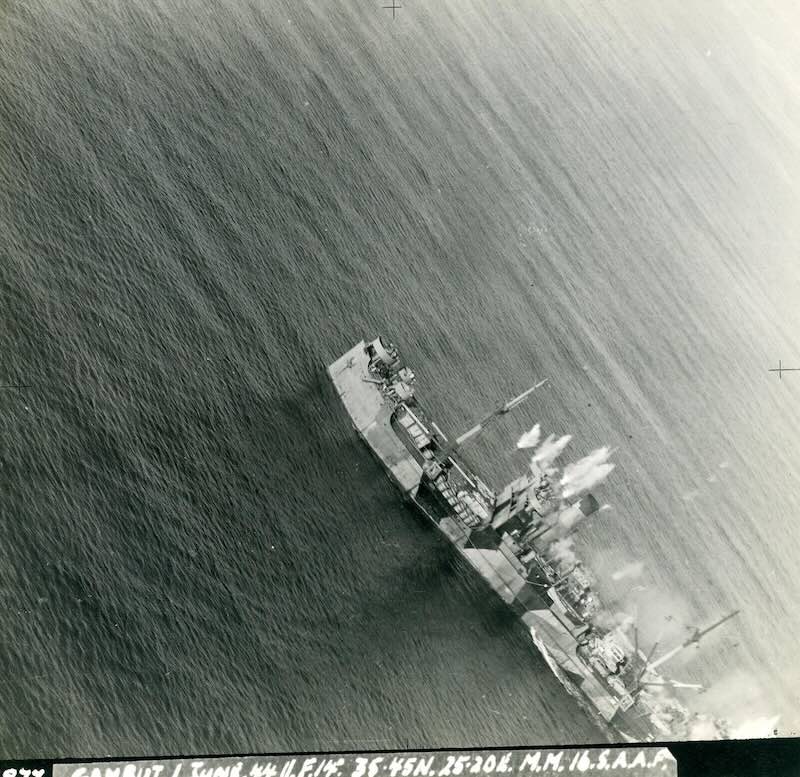
Image: Courtesy of Chris Goss ©
Now leading the beleaguered convoy was the Gertrud. Plt Off Davernport in aircraft ‘F’ fired a full salvo of 60 lb rockets, pounding the bridge and superstructure with high explosive and sending out sheets of flame and smoke into the summer evening air. 9
The Beaufighters of 16 Squadron SAAF were also in the thick of the fray. Capt Muir in aircraft ‘S’ blasted the rear torpedo boat with cannon and fired two rockets which overshot. However, the attack was enough to silence return flak fire. Capt Barrett in aircraft ‘G’ had also gone for the same vessel, scoring several rocket hits on the waterline and bridge. Just as Lt Cruickshanks in aircraft ‘H’ was lining up to launch a full salvo of eight rockets, his Beaufighter was jumped by three Arado 196s. This spoiled his aim and the rockets splashed harmlessly into the sea. Lt Richards in aircraft ‘M’ attacked the Gertrud, raking the stern with a six second cannon burst and scoring at least four rocket hits from a full salvo. The vessel was, as described in the SAAF account, “already burning fiercely with men jumping overboard.” Nearby, an Ardo 196 shot down by Flt Sgt F.G.W. Sheldrick of 227 Squadron RAF came crashing into the sea. 10
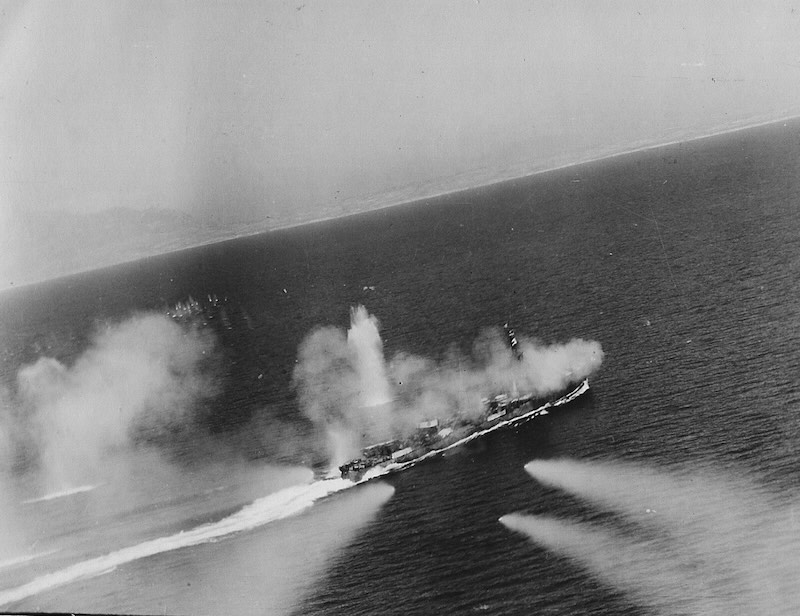
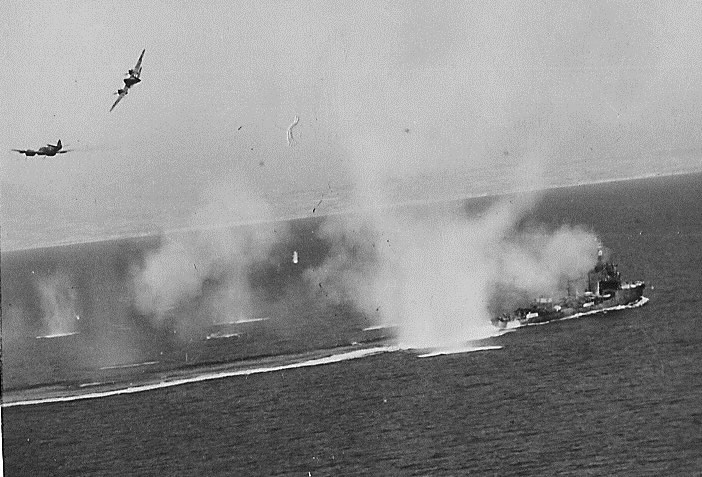
Source: National Archives, UK ©
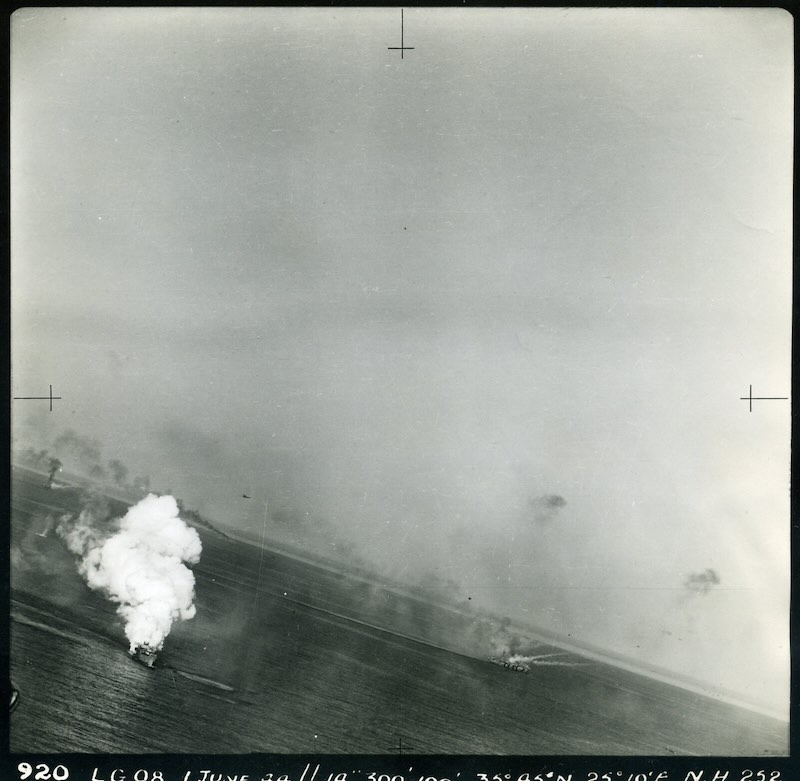
Image: Courtesy of Chris Goss ©
Meanwhile in the skies above, the four ‘top cover’ Mustangs flying in two pairs simultaneously noticed a potential threat to the Beaufighters. Diving down from different approaches, each pair made ready to attack three Arado 196’s at 3,000 ft. However, the first pair somehow mistook the second pair as converging Me-109s. The brief confusion thwarted their intentions and allowed the Arado’s to escape. 11
Capt Barrett of 16 Squadron SAAF was in serious trouble. His beaufighter had been badly hit, forcing a breakaway from the attack. Flying with his port propeller feathered and engine trailing smoke, he jettisoned fuel and headed towards land. 12 13 Radioing in on his VHF set, the message was that he and navigator/rear gunner Lt Haupt would attempt to make it to the western end of Crete. 14 A Mustang shepherded the crippled Beaufighter as it was nursed towards the island. Capt Barrett and Lt Haupt eventually managed to make a successful forced-landing. 15
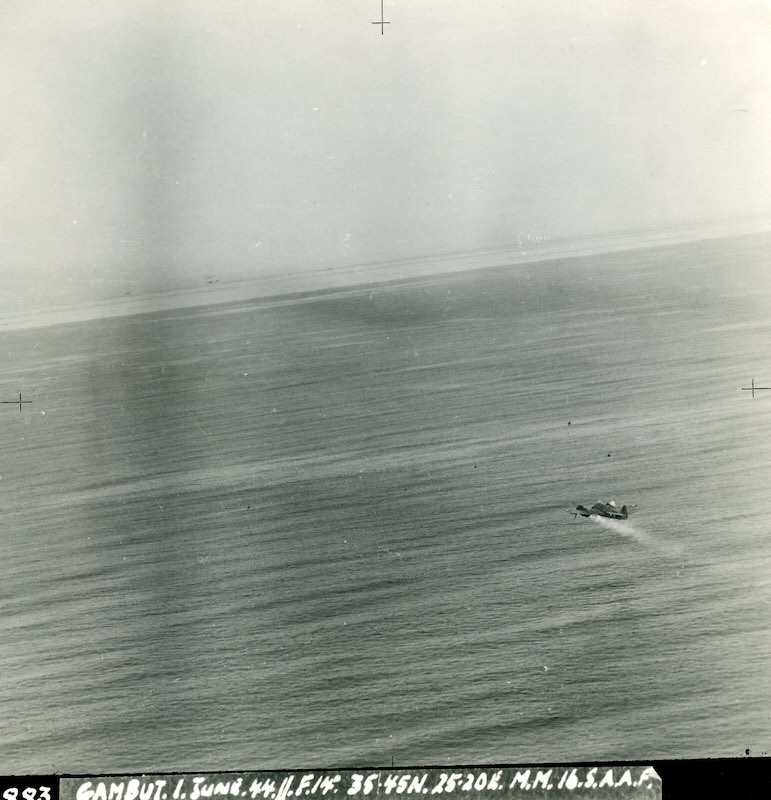
Image: Courtesy of Chris Goss ©
At 19:08 hrs, both Beaufighters of 227 Squadron RAF passed around the north side of the convoy and engaged two Arado 196’s travelling west at 700 ft, preventing them from reaching the strike force. The Beaufighters then flew past the convoy, encountering intense light flak from a torpedo boat. Flt Sgt Sheldrick in aircraft ‘V’, climbed rapidly to attack another Arado 196 at 10,000 ft, raking its fuselage with cannon and machine gun fire and sending it into a deep dive. Lt Richard in Beaufighter ‘M’ of 16 Squadron SAAF saw the ill-fated Arado shortly afterwards as it plummeted into the sea. Flt Sgt Sheldrick went after a Me-109. As he turned on its tail, the German pilot fired explosive bolts to jettison either a drop tank or a rocket tube “in a puff of smoke,” then outpaced the slower plane. Piloted by Fg Off Jones, the other Beaufighter (aircraft ‘W’) later caught up with Flt Sgt Sheldrick. However, Fg Off Jones’ aircraft had been hit, forcing him out of the attack as he desperately worked at the controls. He managed fly on until 19:35 hrs, then “made a good ditching” in the sea at position 35°25′ N, 25°07′ E. A dingy was seen to inflate and after circling for a while, Flt Sgt Sheldrick reported that; “at least one member of the crew, probably both climbed into it.” 16 17
In the mayhem, the Beaufighters of 603 Squadron RAF were also giving their all. Flt Lt Simpson in aircraft ‘O’ and Flt Sgt Harrison in aircraft ‘W’ both achieved multiple cannon and rocket hits on the rear torpedo boat, including strikes below the waterline. Already aflame and billowing smoke aft of its bridge, the torpedo boat was hit again by Fg Off Soderland in aircraft ‘X’ with bursts of cannon fire.
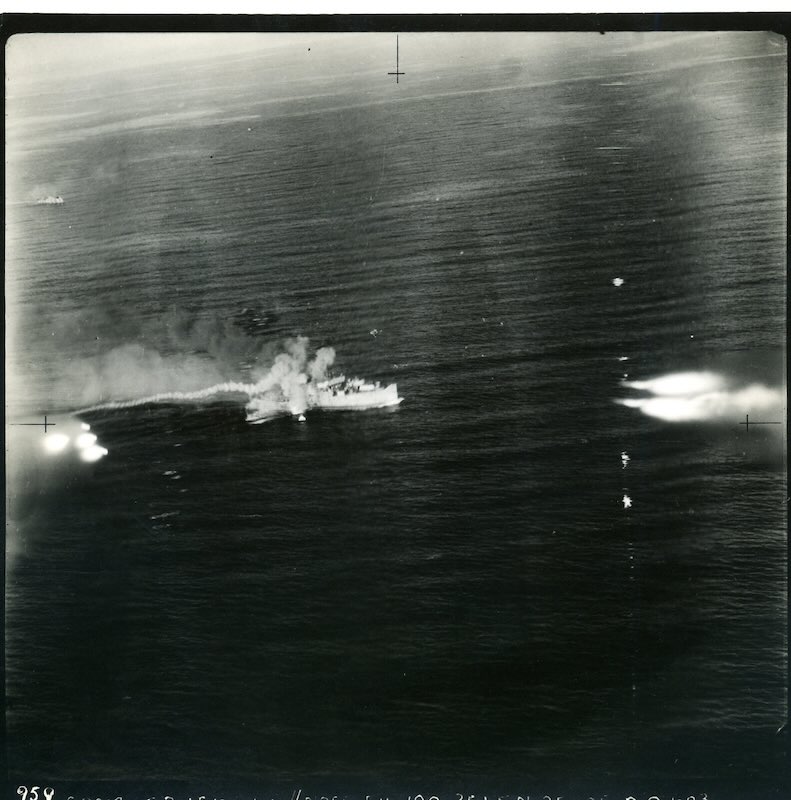
Image: Courtesy of Chris Goss ©
Lining up to attack the lead torpedo boat, Fg Off Hartley in aircraft ‘S’ was ambushed by two Arado 196’s. Although Fg Off Hartley managed cannon strikes, his rockets overshot their target. Presumably angered by the interruption, Hartley immediately turned on his assailants, scoring hits on both. One was last seen “diving steeply, too close to the sea to be able to recover.” 18
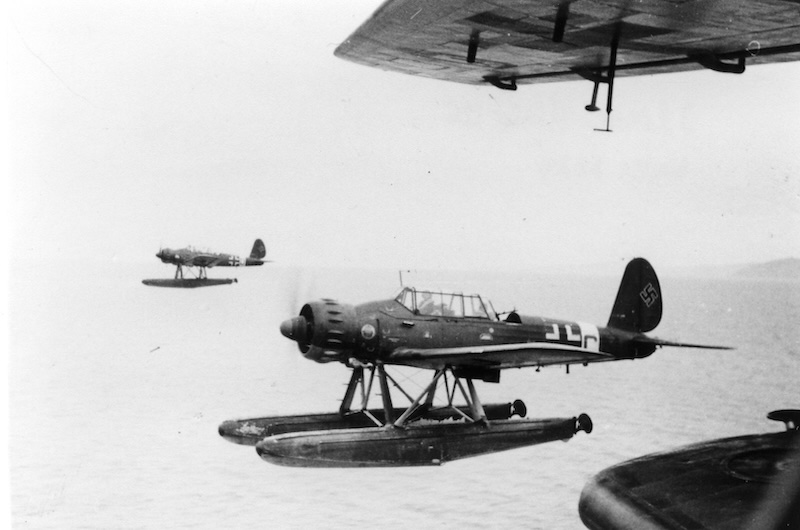
Image: Courtesy of Chris Goss ©
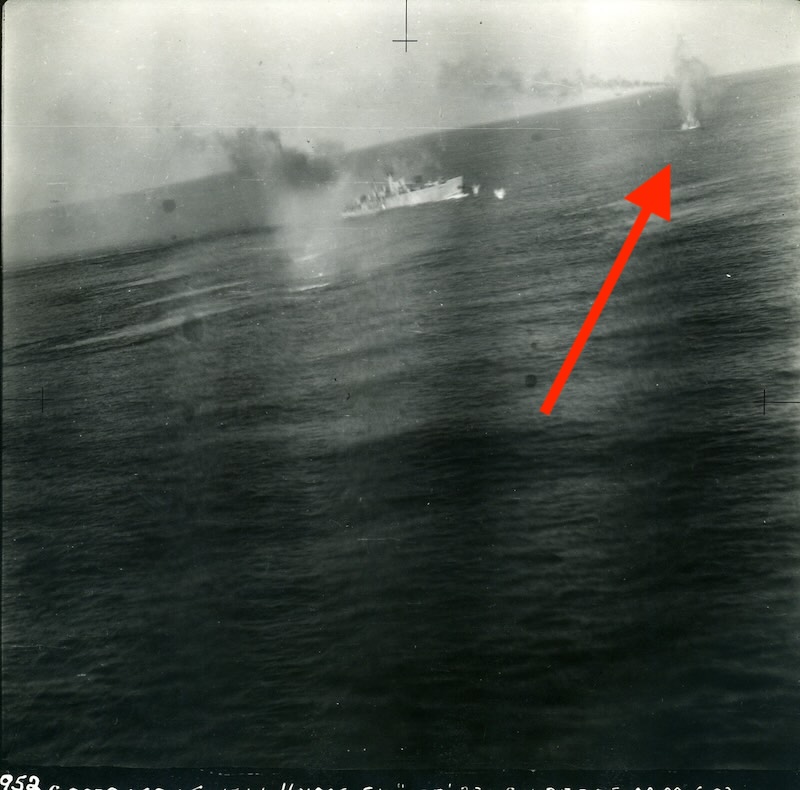
Oblt Loida reports the forecastle erupted into flame and heavy smoke after UJ-2105 was struck. Having been shot up, the ship’s fire extinguishing equipment uselessly flooded the foredeck when an attempt was made to put out the blaze. In addition to machine gun and 20 mm cannon fire, the ship sustained serious RP damage. Two hits below the waterline – one in the forecastle and another in the coal transom – were to be the ship’s death knell. It quickly began to list to starboard as water gushed through the breaches and inundated the inadequately compartmentalised hull. The ship was stopped. However, there simply wasn’t enough time to redress the situation. When capsizing became a real threat just minutes later, Oblt Loida ordered all the life-saving gear thrown overboard and the ship abandoned. 19 20
By 19:15 hrs, another Beaufighter, this time from 603 Squadron RAF, had sustained critical damage and was forced down. Pilot Flt Sgt Atkinson with navigator/rear gunner Flt Sgt Parsons ditched ‘in the drink’, but both survived. The 252 Squadron RAF Beaufighter piloted by attack leader Wg Cdr Meharg (with Fg Off Thompson) suffered a more dramatic end. Critically hit, his aircraft plunged into the water with its starboard wing fully ablaze. 21 On UJ-2101, Oblt Brinckmann reports; “A plane crashes into the sea 50 m away from us, on the starboard side ahead – hit squarely by our forward anti-aircraft guns.” 22 Both men were presumed dead on impact. Miraculously, however, they were later picked up by a pair of Arado 196s and made Prisoners of War (see SURVIVAL AGAINST ALL ODDS).
SURVIVAL AGAINST ALL ODDS: Fellow Beaufighter crews who witnessed Wg Cdr Meharg’s aircraft plummet into the sea so spectacularly assumed (and reported) that he and Fg Off Ernest Thompson could not have possibly survived. However, against all odds, they did. Years later, retired RAF Wing Commander Chris Goss, now a historian and author of many notable books, including ‘Combat over the Mediterranean’ interviewed Wg Cdr Bryce ‘Willie’ Meharg and was given Fg Off Thompson’s account of events. Thompson wrote; “I was wondering vaguely in my confused mind why everything was so still and peaceful and slowly I became conscious of the fact that my body was in water which was steadily coming up to my head. Suddenly I realised fully everything that had happened and knew that I must get out quickly before the aircraft sank.” He goes on to say; “As I came up to the surface, my eye caught sight of the yellow rubber dinghy not more than ten yards away. I struck out for it immediately, only to find that the enemy fire had accounted for this as well – it was holed and useless. However, this shattering blow was temporarily forgotten when I turned to look back towards what was left of the aircraft. There was the nose and the pilot’s cockpit still above the water and I was so relieved to see this that I found myself shouting ‘Willie!’ ‘Willie!’ and trying to swim my fastest at the same time.” Thompson, whose swimming efforts were impeded by a severely wounded left arm, found Meharg alive and hanging on to a floating plank for dear life. Their Beaufighter sank shortly afterwards, leaving both of them clinging to the same plank in a thick slick of oil they could not kick themselves clear of. “Looking away from the convoy, we simultaneously sighted a small yellow object about forty yards away and recognized it as the dinghy pack. What luck!” Removing his boots, Meharg swam and fetched it. The two men opened it “without a word” and climbed out of the water – both were thinking of the Very pistol [i.e. flare gun] inside. It was their only real hope of being spotted by one of the enemy aircraft circling the area. Trouble was, there were only three cartridges. Picking his moment, Meharg fired the first; “We waited with our hearts beating but it was soon obvious that our God-sent effort to claim attention had gone by unobserved.” They were more fortunate on the second, and two Arado 196s came towards them. “One of them did a tight turn directly over our heads and I watched the gunner closely but his guns did not move. He was in a very good position to shoot at us but obviously he had no such intention.” A smoke float was dropped and two Arados landed on the water. Meharg, who had tossed the Very pistol away in case it was mistaken for something else, swam towards one of the aircraft, and Thompson the other. The gunner was standing on the starboard float and ordered Thompson to climb onto the float “in very good English.” Thompson was too injured to manage, so the gunner hauled him out and somehow got him into the cockpit. With his burns now exposed to the air, Thompson was in agony. “…the gunner told me to sit on the floor. I did so and he began to unwrap a first-aid dressing but the aircraft began to leap forward and after a number of bumps, it suddenly became smooth. Never was I so glad to be airborne.” [T4] (Dialogue reproduced with the kind permission of Wg Cdr Chris Goss (RAF Ret’d))
As the UJ-2105 continued to literally keel over, Oblt Loida commends the stoicism of his men; “Through the calm and considered actions of almost all crew on board, it was possible to get all the sailors off. The four seriously and various slightly injured men were placed in the inflatable boats. The dead and missing were not.” Knowing that all confidential papers would soon be out of enemy reach, he turned off the engine and was the last off the ship. Seconds later, it capsized and sank. “Remarkable was the enthusiastic accompaniment of the crew who gave a triple Hurray!” he recounts. 23
The lead UJ-boat on the starboard side of the convoy then became the object of attention. It was hit by Flt Sgt Cook in aircraft ‘R’ by multiple cannon strikes. As he swooped above the vessel, he snagged a trailing wire from a rocket shell fired from below, but fortunately it failed to entangle either propeller. The same UJ-boat was again struck by cannon strikes and seven rockets fired by Fg Off Tame in aircraft ‘K’. Fg Off Tame was then attacked by an Arado 196, which was fired on by his navigator/rear gunner, Fg Off King, as it attempted to pass under the Beaufighter. The UJ-boat was struck a third time by Flt Sgt Pennie in aircraft ‘M’ by a full salvo of rockets. 24
Oblt Brinckmann describes this attack on UJ-2101; “I watch as six planes approach from the side and release four rocket bombs each from close range. Then all that could be heard was the hissing of the missiles, the crack of the shells and the whooshing of flying fragments.” He and others dived for cover behind a recently installed (and later well-praised) 17 mm thick chromium-nickel steel alloy shield. 25 “A rocket hit the aft corner of the bridge and shook us up from behind our protective shield.” One struck the boiler, which erupted and incinerated the engine room and those in it. Another scored a direct hit on the forward 3.7 cm anti-aircraft gun, blasting it off its base before it came crashing back down onto the deck. The forward 2 cm anti-aircraft gun on the starboard side was torn apart. The aft 3.7 cm anti-aircraft gun was blown completely off the ship. “The force of the explosions hurled the aft anti-aircraft crews overboard or forced them to jump [into the water] to avoid being scalded.” In short, it was a level of destruction that can only be described as ‘apocalyptic’. 26 27 28
“When I stuck my nose over the shield for a brief moment, I saw three more aircraft approaching from the front, each firing rockets at close range and dropping bombs as they flew over.” He goes on to report that the 8.8 cm flak crew witnessed one of the bombs hit the forestay on the mask, which deflected it in such a way that when it hit the deck, it began “tumbling down the forward companionway.” Ammunition loaders scattered as the unexploded bomb rolled right over the open hatch which lead down to the ship’s magazine. Only then did it detonate, destroying the forecastle in a fireball. The fact that it had not fallen down the hatch and blown them all to smithereens is ascribed by Oblt Brinckmann to only be “thanks to the hand of God.” 29
According to Oblt Brinckmann and confirmed by those forced into the water;“We were also treated to on-board weapons less than 4 cm in calibre during the fly-over” – the somewhat sardonic statement meaning that in addition to the devastating rocket attack, they were also strafed by Beaufighter cannon and machine gun fire (see BEAUFIGHTER TACTICS). 30

Courtesy of Dr Scott Robertson
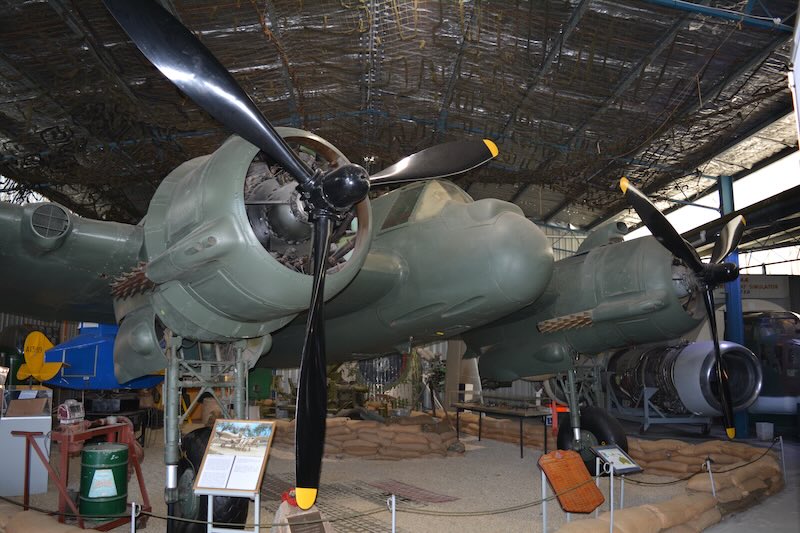
BEAUFIGHTER TACTICS: While attacking shipping, it was a standard tactic for a Beaufighter pilot to fire the four nose-mounted cannon at the target before releasing RPs. (Rocket Projectiles). Not only would the cannon shells cause significant damage, but as the strikes could easily be seen, it would help align the aircraft for the ensuing R.P. strike. [T5] Nevertheless, in the absence of any electronic guidance system, success entirely depended on how keen the pilot’s eyes and coordination were. As specified in the 16 Squadron SAAF record of the convoy attack, after release, the pilot would “dive to the deck immediately after firing rockets and weave violently until clear.” [A4] Although exact weapon configurations were often changed to meet circumstance, a well-established attack doctrine was that Beaufighters armed with six .303 in Browning machine guns, four nose-mounted .787 in (20 mm) Hispano Mark III cannon and bombs (or 25 lb solid-shot RPs) would suppress anti-aircraft flak fire, allowing those equipped with torpedoes (or the larger 60 lb solid-shot RPs) to make their main strike attack runs. In June 1944, RPs were a relatively new weapon, as indicated by the assessment on the convoy attack found in 16 Squadron’s Review of Operations; “…the comparatively small Beaufighter losses for the excellent results achieved indicate what may be accomplished by a properly constituted strike-force of Rocket Beaufighters attacking after adequate anti-flak preparation by a suitably large number of anti-flak Beaus.” Moreover, in reference to the success of the convoy attack, HQ 212 Group states that; “It is also a great encouragement for the future of the rocket as an anti-shipping weapon.” [A5] In fact, tactics were still being refined. A new variant of the anti-flak suppression strategy was employed for the first time during the convoy attack. Instead of immediately breaking away, the first wave of flak suppression Beaufighters continued to fly straight on, right over the convoy. While this may have put them more at risk, it created a distinct disadvantage for the enemy. When the main strike Beaufighters armed with 60 lb rockets attacked seconds later, the anti-aircraft guns on-board the escort vessels would be facing the wrong direction to foil the second, more deadly wave. [A6]
With all their rockets spent and most of their cannon shells fired, the Beaufighters finally broke off their attack. Because of the extreme proximity, many had been severely holed by flak. 31 Nonetheless, they were still flying, so a course was set for home. Skirting around Crete via the island of Kasos to the north east, they began landing at their respective airfields after 21:00 hrs. Recorded somewhat dispassionately in the archives is that four of their number “failed to return from this operation.” 32
THE AFTERMATH
The attack left the convoy in an appalling state. Raging fires, palls of smoke, and many Kriegsmarine sailors dead, wounded or dying. All three merchantmen were ablaze and the Sabine and Gertrud both totally crippled.
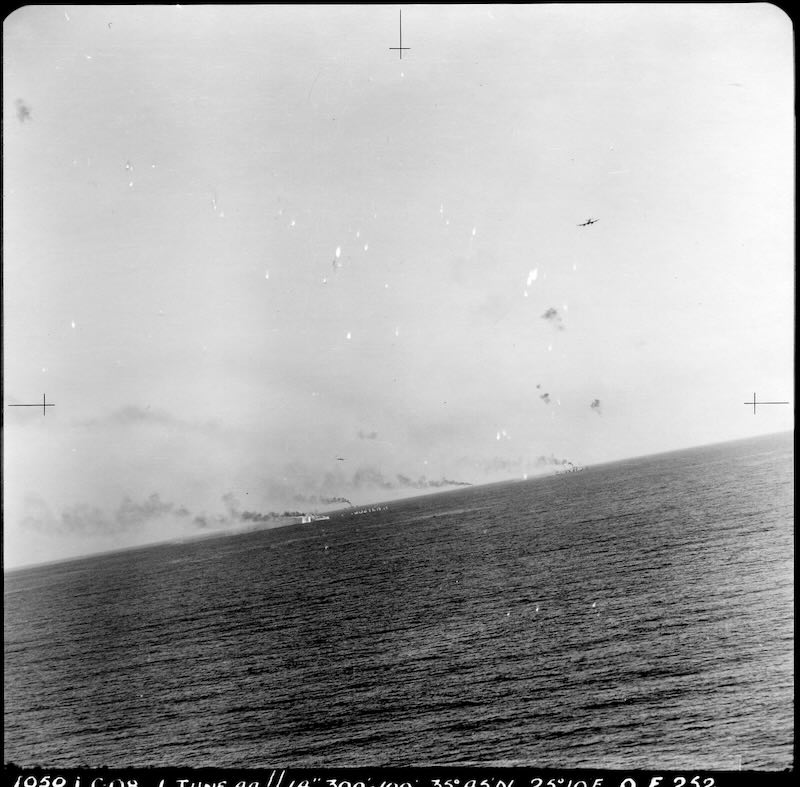
On UJ-2101, Oblt Brinckmann continues; “When the inferno had cleared and I saw the devastation on the upper deck, I couldn’t believe that any soldiers were still alive there.” 33 He gave orders to deal with the forecastle fire and attend to the wounded. Realising that the ship could sink at any moment, he also ordered sensitive papers and codebooks destroyed. 34 Despite having been damaged itself, R-211 pulled alongside to help with the fire. However, it was soon apparent that UJ-2101 had to be abandoned. The Flotilla Commandant, Korv Kapt Dr. Brandt, was onboard during the attack and had suffered a severe shoulder wound. He was evacuated with the other survivors. 35 “The brave attitude of the wounded, who did not let a sound of lamentation be heard, deserves special praise,” Oblt Brinckmann extolls his men. 36
At 18:25, Oblt Brinckmann received confirmation that the ship’s key and all sensitive papers unable to be saved had been destroyed. Although the R-211 would continue to pluck survivors from the sea for some time, all others had abandoned ship. The brevity of his next comment surely hides the emotions of all concerned; “I am last to leave the sinking ship at 18:29. At 18:30, U-Jäger 2101 sinks from the stern, accompanied by three cheers from its crew.” 37
The destruction was reported by Fkpt R.K. Dominik, Kriegsmarine Commandant of the 9th Torpedo Boat Flotilla and is recorded in the German Naval Staff, Operations Division War Diary. [T2] The submarine chasers UJ-2101 and UJ-2105 had been sunk outright. However, 66 men from UJ-2101, along with the 21st Anti-submarine Flotilla Commandant (Korv Kapt Dr. Brandt) and the Commanding Officer (Oblt Brinckmann) had been rescued. Moreover, most of the crew from UJ-2105 had survived, including its Commanding Officer (Oblt Loida). The torpedo boat TA-16 and minesweeper R-211 had been damaged, but somehow made it to Crete under their own steam. Only lightly scathed, UJ-2110 had survived what its Commanding Officer (Oblt Beger) likened to “being in a witch’s caldron.” 38 It headed towards Candia Harbour with the Tanais and TA-17. After picking up survivors from UJ-2105, 39 TA-19 took the burning Gertrud under tow, arriving in Harbour at 04:30 hrs the following day. TA-14 stayed with the Sabine as fires and explosions still ravaged the ship. Whether it could be saved or not remained doubtful. The situation was summarised as follows; “These losses are extremely serious to our shipping in the Aegean, especially as regards Crete supplies.” 40
As for German air losses, the Allies conservatively claimed one Me-109 and one Arado-196 definitely destroyed, with two more Arado-196’s probably destroyed and another damaged. 41 Verification remains impossible owing to the incompleteness of surviving Luftwaffe records. The exact composition of the defending force also remains undetermined. 42 According to the German Naval Staff War Diary entry of June 2nd; “The Crete convoy sailing on 1 June was protected by strong air escort. When the enemy attacked, twenty-five of our own planes were over the convoy.” 43 This number seems inexplicably high. In addition to the four aforementioned Arado-196’s of 4./SAGr. 126 (4 Staffel/Seeaufklärungsgruppe 126 – 4 Sqdn of Maritime Reconnaissance Group 126) stationed at Suda Bay, 44 the German aerial escort comprised several Me-109’s, probably from a squadron attached to III./JG. 27 (Gruppe 3/Jagdgeschwader 27 – Group 3 of Fighter Wing 27) but possibly from 5./JG. 51 (5 Staffel/Jagdgeschwader 51 – 5 Sqdn of Fighter Wing 51). Five Ju-88’s, most likely from 3./AG. 33 (3 Staffel/Aufklärungsgruppe 33 – 3 Sqdn of Reconnaissance Group 33) were also involved. 45 However, being too slow and cumbersome, they did not engage 46 – a point not lost by those aboard UJ-2110; “From our perspective, you could only see the Ardos in opposing combat, while the 5 Ju-88s apparently flew wide reconnaissance at the time of the attack.” 47
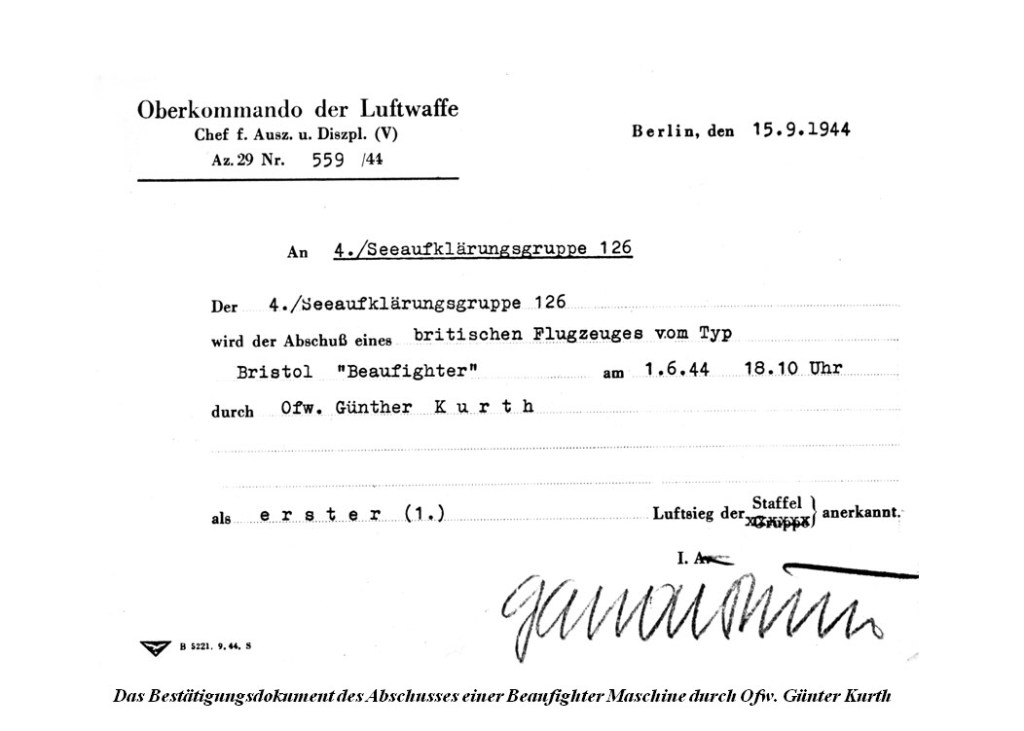
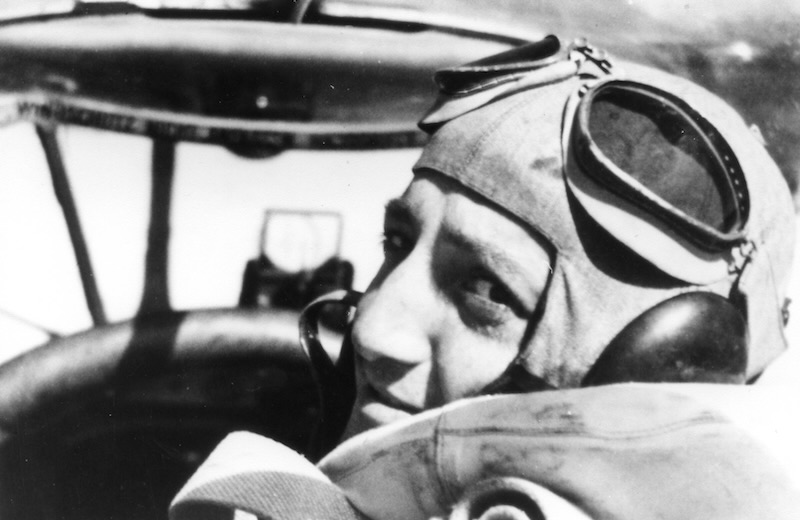
Image: Courtesy of Chris Goss ©
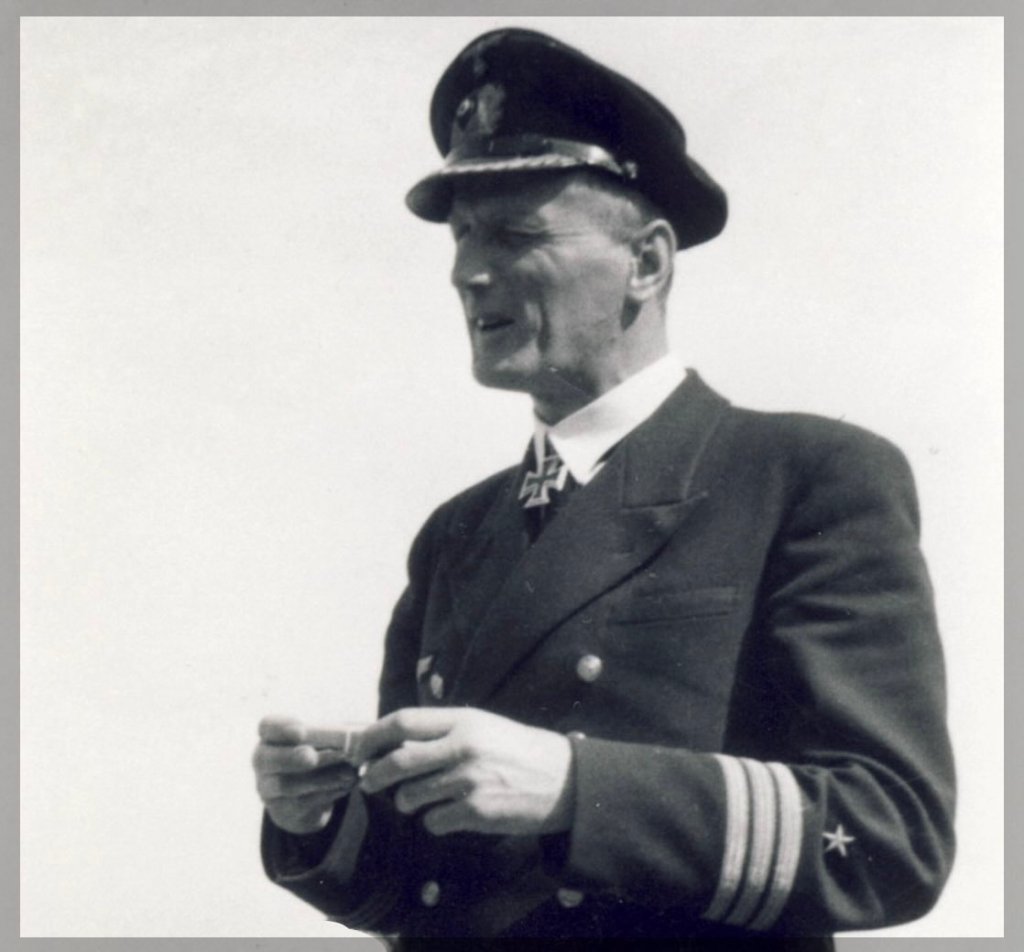
Of the German pilots who were in the thick of it, the archival evidence suggests that a sterling effort was made. This is particularly true of the Ardo-196 crews who braved dogfights in their unwieldy floatplanes. However, it is highly unlikely that more than ten German aircraft actually defended the convoy against an Allied total of seventy-one. Indeed, Commanding Admiral, Aegean Kurt Fricke, who was ultimately responsible for Operation ‘Olive Oil’, squarely laid the blame on inadequate Luftwaffe cover, going as far as to say that; “Air escorts only have a psychological value for our convoys.” 48
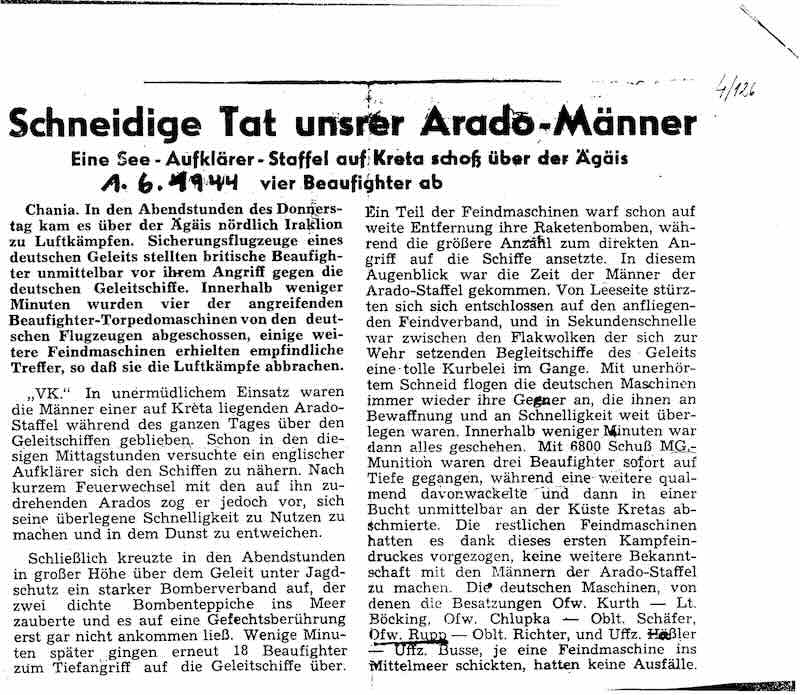
In addition to the loss of a 454 Squadron RAAF Baltimore during the shadowing phase of the operation, 16 Squadron SAAF and 227, 252, 603 Squadrons RAF each lost a Beaufighter, with most crews assumed to have survived and taken prisoner. 49 The German records hold that 4./SAGr. Arado 196 pilot Ofw Günther-Werner Kurth (with Ofw Kurt Chalupka navigator/rear gunner) shot down one of those Beaufighters (documented on June 1st, 1944 at 18.10 hrs). 50 Moreover, an article in the German military newspaper published on Crete, ‘Festung Kreta’ states that in addition to Ofw Kurth’s success, three other Arados 196s shot down a Beaufighter each. 51 52 [T6] While it is entirely possible that one of the four Beaufighters was actually shot down by an Arado 196 rather than less discriminate flak, this second claim is generally considered unfounded propaganda.
By all accounts, the operation was a major achievement for the Allies and testimony to their organisational skills. Air Officer Commanding, 212 Group sent the following message: “Air Marshal Park sends congratulations to all Squadrons that took part in the most successful attack on enemy convoy North of Crete yesterday evening June 1st. The Baltimores that hung on to the convoy throughout the day in spite of fighter opposition deserve special mention. The whole attack by Bombers, Beaufighters, and their Fighter escort was first class and showed excellent team work by all Squadrons.” 53
DOWN, BUT NOT OUT
Notwithstanding this success, eleven Consolidated Liberator B-24 Mk VIs of 31 Squadron SAAF out of Gebal Hamzi, Egypt teamed up with eight Wellingtons of 38 Squadron RAF to bomb the remnants of the convoy in Candia Harbour during the early hours of June 2nd. No direct bomb hits were observed. 54 However, heavy flak hit several bombers, including the Wellington piloted by Flt Lt Meadowcroft. While nursing the damaged aircraft back home, a propeller flew off and a cylinder pot of one of the radial engines was blown straight through the fuselage, severing the controls and forcing the plane down. It crashed at 03:15 hrs, 40 yrds off the beach just 4 miles northeast of the RAF airfield at Tocra in Cyrenaica. Although severely injured, half the crew survived. The other three, including the pilot, perished. 55
The Allies were completely unaware that TA-14, TA-17, and TA-19 had narrowly escaped the attack and were steaming for Piraeus (which they would reach at 14:15 hrs the same day). Meanwhile, UJ-2110 had been joined by UJ-2142 to help work against the fires still raging on Gertrud. At 05:55 hrs, R-211 and R-34 anchored off Dia, a small uninhabited island north of Heraklion. 56 Leaving the smouldering Gertrud to the harbour firefighting crews, UJ-2110 and UJ-2142 also reached the safety of Dia by early afternoon after the latter had swept the area in front of the harbour for submarines. 57
At 09:45 hrs a pair of 213 Squadron Mustangs were sent to reconnoitre the exact fate of the convoy. They spotted debris and oil from the attack, along with several small craft and one large caique (sailing vessel) thought to be looking for survivors and/or salvaging wreckage. While there was no sight of the Sabine, they saw the Gertrud in the middle of Candia Harbour “on fire astern.” 58 Later high altitude photo reconnaissance undertaken by a de Havilland Mosquito XVI of 680 Squadron RAF 59 confirmed Sabine’s absence, giving credence to the assumption that it had “burned out completely and sank” 60 the previous day. In fact, as the War Diary of the Admiral, Aegean specifies, it had actually been scuttled by a German torpedo. 61 The badly damaged TA-16 was tied up against the northwest breakwater with a perilous 25% list. The other escort vessels were nowhere to be seen. Blackened by fire damage but “apparently intact,” the Tanais was moored on the southwest quay. 62
With these residuals, the convoy was obviously down, but not out. As the substantial anti-aircraft defenses around Candia Harbour would have pulverized any close-quarter attack attempted by Beaufighters, it was only the bomber squadrons of the June 1st attack which were called into action once again.
Eleven Marauders and Eleven Baltimores (escorted by fourteen Spitfires) 63 attacked the merchantmen at 18:38 hrs from heights ranging from 11,000 to 14,000 ft. While bombs overshot the Tanais, there were many near misses on the Gertrud. However, according to the 15 Squadron SAAF Operations Report; “[a] stick of bombs fell from N/W quay across stern of ship scoring one possible direct hit.” Heavy flak holed four Marauders and five Baltimores. To extend range, the latter often had extra fuel tanks mounted in their bomb bays instead of a full complement of bombs. One of the SAAF Baltimores had flak shrapnel tear through its bomb bay tank. By some miracle, it did not explode. Nonetheless, all the fuel drained out in three minutes, thereby seriously imperilling the aircraft’s return journey. 64 65 66
This time, enemy aircraft intervention was virtually non-existent. 67 68 However, there was an anxious moment when three fighters were seen 700-800 yrds distant by a rear turret gunner in one of the SAAF Baltimores. As two of them approached, he opened fire with his twin .303 in machine guns at 200 yrds. The fighters broke away, their elliptical wings plainly revealing themselves as Spitfires. They had been chasing the third fighter, an Me-109, which did not open fire but slipped by the Baltimore formation on the port quarter. 69
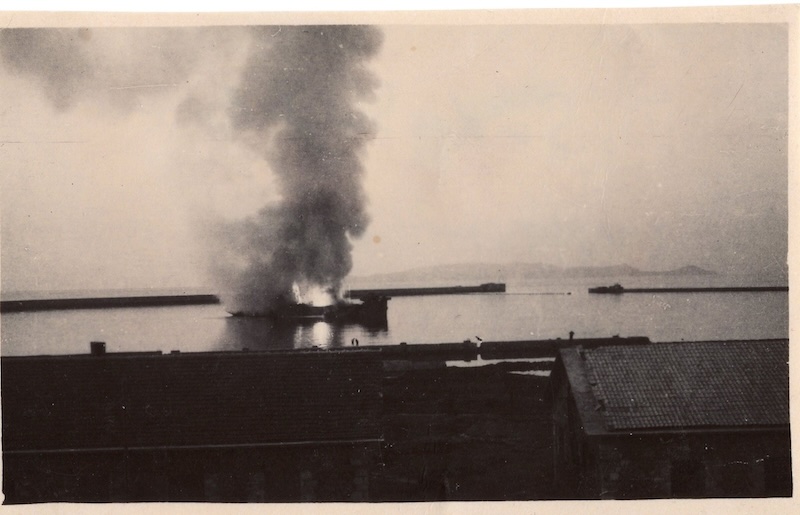
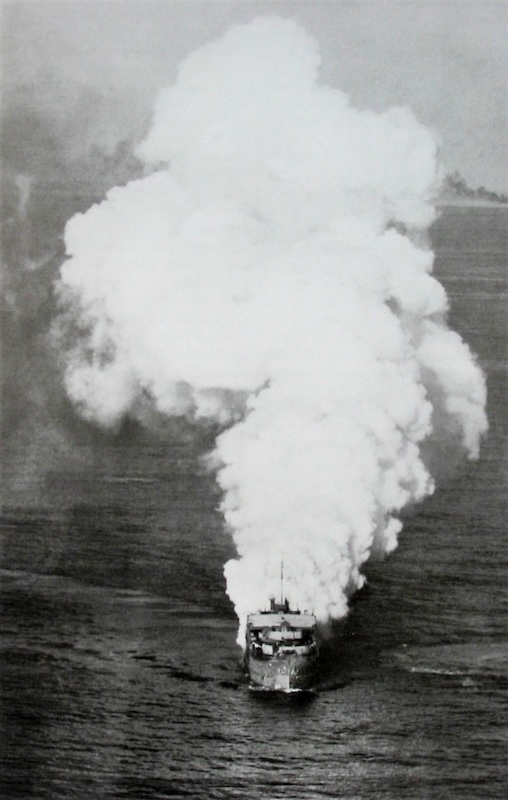
Unbeknown to the Allies until the following day, this latest attack had been successful. German Naval Staff War Diary entries on June 2nd and 3rd stipulate that the Gertrud sank in harbour on the evening of the 2nd, following “a heavy explosion in the forward part of the ship” at 19:18 hrs. It had been struck amidships and the ensuing fire spread forward and ignited a cargo of ammunition. The resultant blast virtually obliterated the ship, the wreck of which now lay in the middle of the harbour “totally submerged, except for the masts.” (see featured photographs) 70 71 It also capsized TA-16 on its mooring lines and 72 caused substantial damage to the buildings surrounding the harbour and the town itself. 73
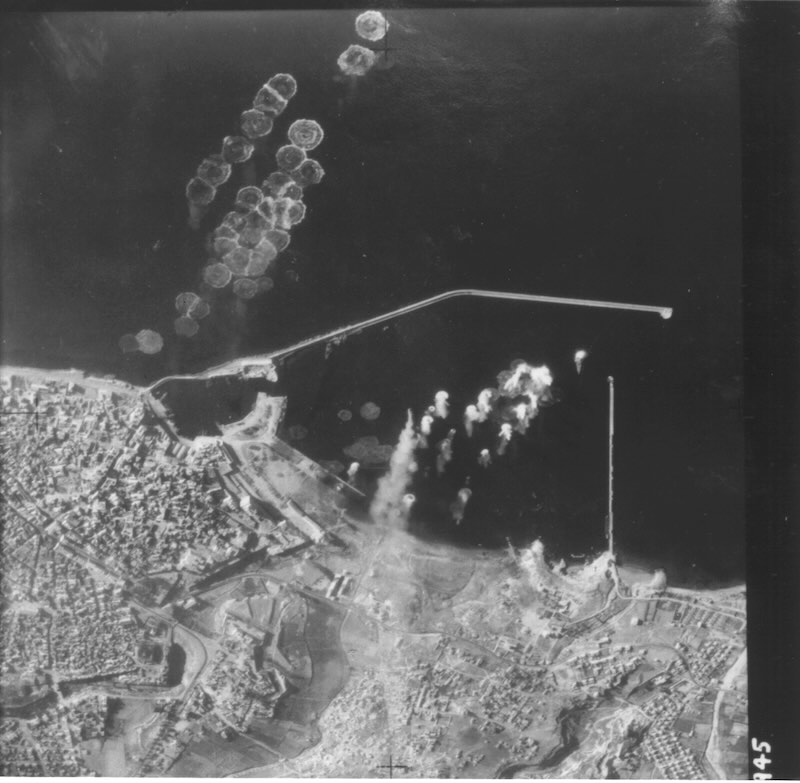
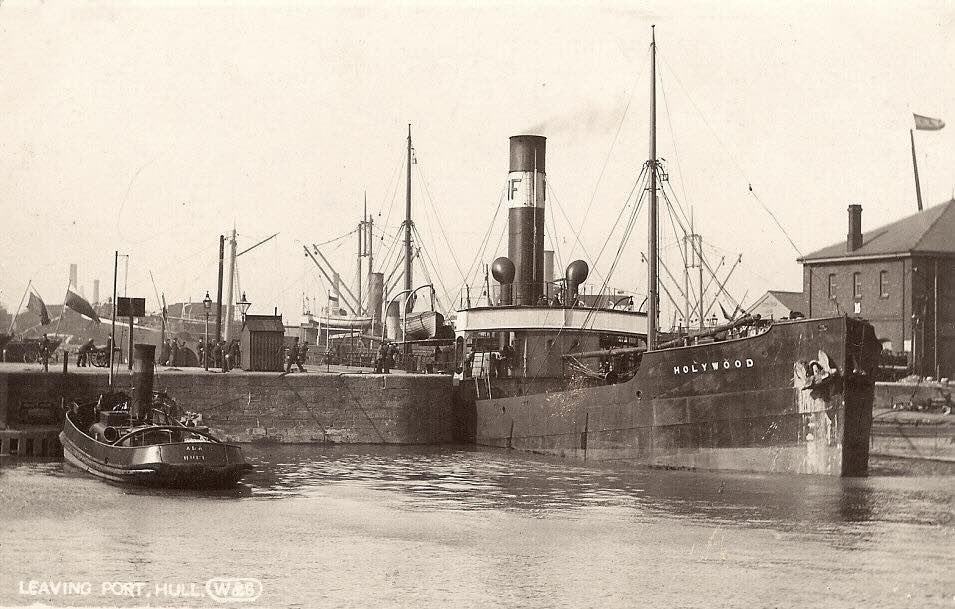
Subsequent photo reconnaissance on June 3rd revealed the Tanais and part of the quayside to be “much blackened, as if by fire.” This aroused an interesting suspicion which is recorded in the 15 Squadron SAAF Operations Review for June 1944; “The fact that the ‘Tanais’ was considered to be burnt out may have been very effective camouflage on the part of the enemy, as the ship finally discharged all its cargo, and later moored against the Northern mole [breakwater], preparatory to sailing again.” 74
A CHARMED LIFE
In line with the superior resources at their disposal, the Allied bombing efforts against the Tanais in Candia Harbour continued. This time, ‘the big guns’ would be rolled out in the form of heavy bombers. Ten Liberators of 31 Squadron SAAF bombed at 22:16 hrs from 14,200 ft on the night of June 3rd. Although conditions were hazy, one burning vessel was reportedly seen and extensive damage to warehouses caused. This attack was independently observed by a Beaufighter of 252 Squadron on lone patrol; “At approx. 23:00 hrs, a bombing raid was made on Candia and our aircraft could see flashes and flak in the harbour area.” 75 However, after the fires were extinguished and the dust settled, the Tanais emerged undamaged yet again. On this occasion, the cost was to the Allies. In those inauspicious words of officialdom, the Liberator piloted by Capt Duckett “failed to return” – the cause unknown. All eleven crew were lost. 76
The Germans were then given a few days of unintended respite. Poor weather, first over the target area and then over both Crete and the North African coast impeded further Allied operations. 77 When it abated, persistence soon shone through and Candia Harbour was bombed again at 13:26 hrs on the 8th, but to no avail. However, flak punched holes in almost all eighteen aircraft and two crew returned wounded (one with a shard of Perspex lodged in his eye). 78 79 80
That night, 81 ten Liberators of 31 Squadron SAAF set out in the hope of finally bringing the Tanais down. Typically, one aircraft failed to take off because of technical issues and another was forced to retire due to engine trouble. 82 However, when the remaining eight aircraft arrived over a hazy target area at 23:35 hrs (altitudes 14,000 to 17,000 ft) there was; 83 “No ship seen at NW mole.” 84 The Tanais had already slipped out of harbour – but the bombs were dropped anyway. 85
THE FINAL DEATH BLOW
Despite the perseverance shown by both planners and aircrews alike, the Allies had totally failed to hit a stationary target in the confines of Candia harbour on five separate occasions. It had cost them two aircraft – a Wellington and a Liberator – with fourteen airmen dead. But if any remorse was felt by those at HQ 212 Group, it was about to be thrown into sharp relief. The end to Tanais’ seemingly charmed life – and therefore the convoy’s final death blow – was soon to be delivered from an unexpected quarter.
The Tanais was now steaming for Piraeus. During the early hours of June 9th, it was about 35 miles north-east of Heraklion accompanied by UJ-2142, along with the smaller auxiliaries GK-05 and GK-06, as protective escort. 86
Lurking in the waters off northern Crete on an anti-shipping patrol was the submarine HMS Vivid (Lt J.C. Varley, RN). The entries made in the submarine’s logbook best describe events;
“02:31 hrs – Sighted an object that was later identified as the German merchant Tanais escorted by three or four smaller vessels.
03:08 hrs – While the target was at 3,500 yards, Lt Varley dived to make a submerged torpedo attack.
03:12 hrs – Fired four torpedoes from 2,400 yards. 95 seconds after firing the first torpedo an explosion was heard followed 12 seconds later by a second explosion. After firing the torpedoes Lt Varley took Vivid to 300 feet but no counter-attack followed.
05:09 hrs – Returned to periscope depth. There was nothing in sight.” 87
The Tanais had finally been dispatched and sent to the bottom. 88 The sinking is confirmed in the German Naval Staff War Diary; “At 03:13 on the 9th, the steamer TANAIS (154.5 BRT) was sunk by torpedoes of a submarine south of Santorin. [Santorini]” 89 Expunged from the surface in mere moments, there was very little hope of survival. 90
Charged with ridding the Aegean of German supply shipping, the submarine commander was totally oblivious to the human tragedy his torpedoes had just caused. In addition to a ships’ crew of a dozen men, there were also at least as many anti-aircraft gunners. Although exact numbers vary, crammed in the cargo spaces of the hold were some 500 prisoners, 270 of whom were Cretan jews destined for concentration camps. About 100 prisoners were Italians and another 100 were children. According to one source, there were only around fifty survivors, the majority of whom were German. 91 92
ALLIED VICTORY
Official archival records are generally devoid of absolutes or emotion. However, across many RAF, RAAF and SAAF sources, the June 1st attack was alluded to with undeniable flourish; “June 1st. 1944 stands out as one of the big days in the history of 454”, 93 a proverbial “highlight operation”, 94 with the “excellent results achieved” 95 being further delineated with explicit words such as “liquidation” 96 and “decimated.” 97 HQ 212 Group’s own description was; “This attack was the largest anti-shipping strike of the war in the Eastern Mediterranean, and the results make it certainly one of the most effective.” 98
A message was sent out from the Air Officer Commanding (RAF A.HQ Eastern Mediterranean), Air Vice Marshal Richard Saul; 99 “As various ships cannot be found, I think we may now safely claim them as resting in the arms of Neptune and I wish to congratulate everybody on their very great success in the last few đays. The perfect reconnaissance of 454 Sqdn and the excellent work on the part of the bombers and their escorts, especially 15 S.A.A.F. and the magnificent show of the Beau forces may well result in one of the greatest defeats the enemy has suffered in the Aegean, Finally, I would like to express my thanks to the ground crews and maintenance personnel whose efforts have enabled us to put so many Aircraft into the air. Your patience has been rewarded and Gerda Toft [Gertrud] is no more.” 100
THE IMPACT ON THE AEGEAN SUPPLY WAR
Needless to say, the demise of the ‘Olive Oil’ convoy was completely overshadowed by the enormity of the D-Day landings in Normandy days later on June 6th. However, the event remained significant in its own right as it not only eliminated three merchantmen the Germans could ill afford to lose, but it also exposed an increasing threat to those precious few cargo steamers which were left. With large convoys now out of the question, even more reliance was placed on small auxiliary sailing vessels known as caiques to supply Crete and the Aegean islands. If that was not restrictive enough, they were also obliged to travel “in groups no more than three or four” so as to avoid attention. 101
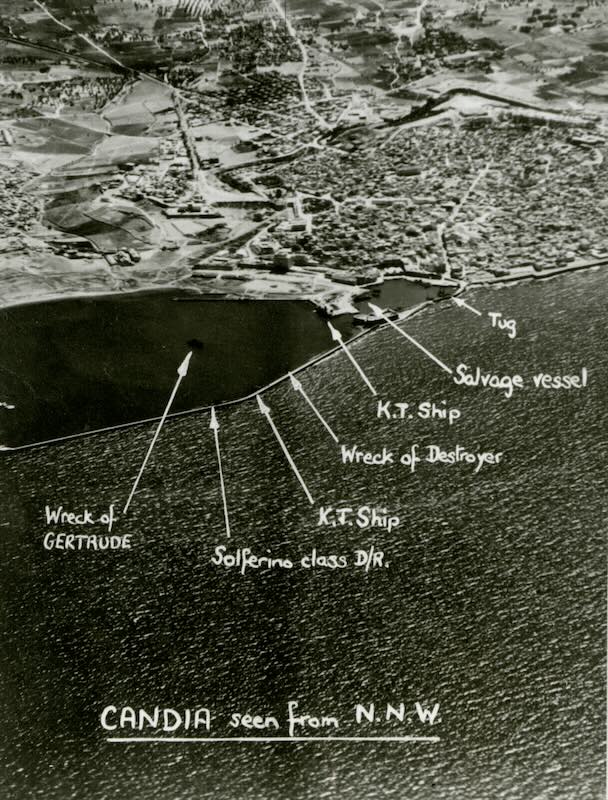
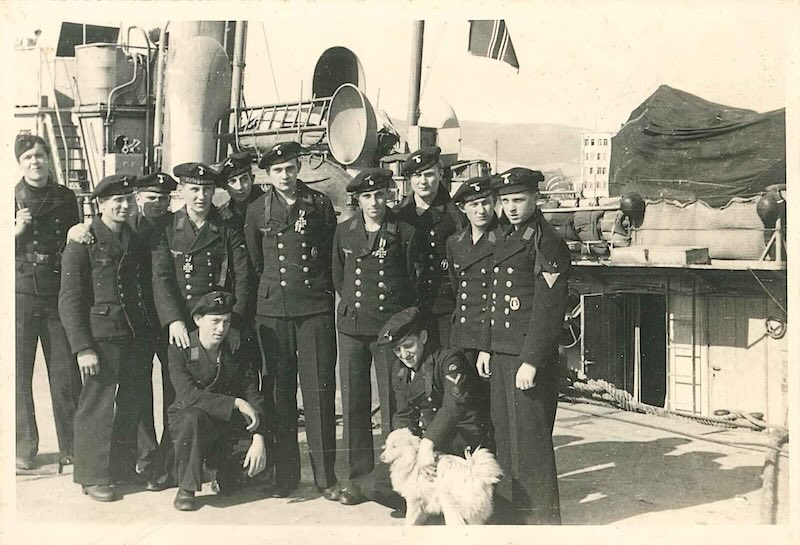
Image: Dimitri Galon ©
As their options and resources waned, the Germans were to face increasingly harder times in the region to the point when the occupation itself became untenable. By August, support from former Axis allies Romania and Bulgaria wavered and collapsed as the Russians advanced. With the overland supply and communication lines to Vienna thus threatened, Hitler was forced to decree “a loosening up” of German occupation of the Ionian and Aegean islands on August 27th. 102 103 [T7] It was to become the prelude to a full-scale evacuation of the Greek mainland and the mass movement northwards of men and equipment throughout September and October. 104 [T8]
The evacuation created a growing power vacuum and an enticement for the Allies to simply step in and take control. The German counter-strategy was to turn key islands – the main ones being Rhodes, Leros, Kos, Samos, Melos and Crete – into veritable fortresses to protect the flank and forestall imminent invasion. It meant that the Aegean Supply War was far from over – in fact it suddenly became more important than ever to bolster what remained of the Aegean garrisons. A Sept. 24th directive issued by German occupiers, Army Group E which primarily concerned Crete and Rhodes could not be clearer; “It is ordered that; in case the evacuation has to be discontinued, the inner fortress is to be defended as long as possible, to the last cartridge, so as to tie down strong enemy forces, thereby relieving the pressure from operations on the mainland and alleviating the defence of the homeland.” 105
Left behind in the Aegean were heavily fortified garrisons comprising 26,500 Germans, 106 along with a considerable number of co-belligerent Italian soldiers. Although now completely cut-off, these garrisons had somehow procured supplies that would allow them to put up a defiant resistance for many months. On most islands, including Crete – where 13,694 diehard Germans held out on the western side of the island – capitulation would not come until the end of the war in Europe was officially declared in early May 1945. Thus, it was only when the Third Reich finally fell that the Aegean, and Greece as a whole, was liberated.
It also means that in a sense, the Aegean Supply War had actually been won by the Germans.
ACKNOWLEDGEMENTS
The authors wish to thank Wg Cdr Chris Goss (RAF Ret’d) and Air Cdre and Historian Dr. Mark Lax (RAAF Ret’d) for their invaluable contributions and insights. Gratitude is also extended to authors Byron Tesapsides, Henry L. deZeng IV and George Karelas for their indispensable tolerance and advice.
Delve Deeper
ww2stories.org offers you a chance to Delve Deeper into the story by exploring our additional materials and footnotes.
English translation of the German newspaper account of the ‘Olive Oil’ convoy attack (German version can be found in Footnotes here 107):
Daring Action by Our Arado Crews
A Naval Reconnaissance Squadron on Crete Shot Down Four Beaufighters Over the Aegean.
Chania. On Thursday evening, intense aerial combat erupted over the Aegean, north of Heraklion. Escort planes from a German convoy intercepted British Beaufighters just as they were about to attack the convoy ships. Within minutes, four of the attacking Beaufighter torpedo planes were shot down by German aircraft, while several others sustained heavy damage, forcing them to retreat.
The men of an Arado squadron stationed on Crete tirelessly patrolled over the convoy throughout the day. Around midday, a British reconnaissance aircraft attempted to approach the ships. However, after a brief exchange of fire with the Arados, which aggressively closed in, the British plane used its superior speed to escape into the haze.
In the evening, a strong bomber formation, flying at high altitude under fighter cover, appeared over the convoy. The bombers dropped dense patterns of bombs into the sea but failed to engage directly. Shortly thereafter, 18 Beaufighters launched a low-altitude attack on the convoy.
Some of the enemy planes fired their rocket weapons from a distance, while the majority moved in for a direct assault. At this crucial moment, the Arado squadron sprang into action. Boldly attacking from the windward side, they engaged the incoming enemy. Within seconds, the skies over the convoy, filled with flak bursts from the escort ships, turned into a swirling dogfight. Despite being outgunned and outpaced by their adversaries, the German pilots launched repeated, fearless attacks.
The battle was over in minutes. With a total of 6,800 rounds of machine-gun ammunition, three Beaufighters were brought down immediately, while a fourth, trailing smoke, crashed into a bay near the Cretan coast. The remaining enemy planes, evidently shaken by this first engagement, chose to withdraw and avoid further encounters with the Arado squadron.
The German crews, each responsible for downing one enemy aircraft, were: Ofw. Kurth and Lt. Böcking, Ofw. Chlupka and Oblt. Schäfer, Ofw. Rupp and Oblt. Richter, Uffz. Haddler and Uffz. Busse.
All German aircraft returned without any mechanical failures.
We value your opinion!
Your feedback is important to us. If you enjoyed this article and would like to see similar content, show your appreciation by clicking the ‘Claps’ icon below. Also, ensure you stay up-to-date with our latest articles by subscribing to our Newsletter. You’ll receive new posts directly to your email inbox. Thank you for your support!
‘History has to be shared to be appreciated’
It’s FREE! Subscribe to our Mailing List. We’ll keep you in the loop.
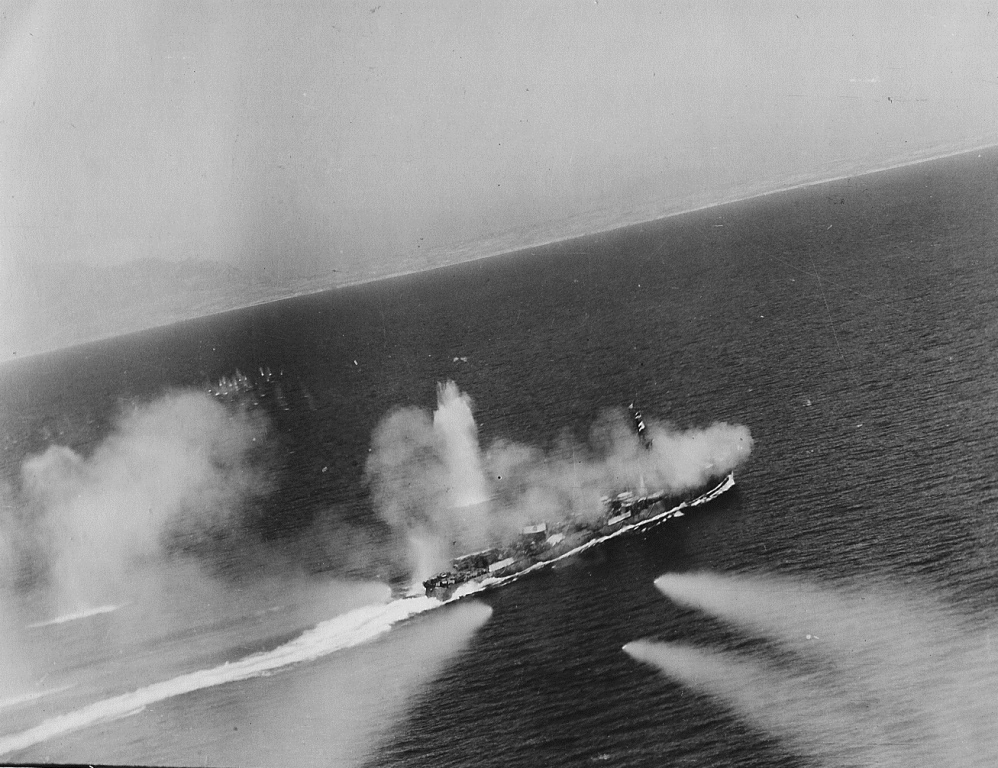
Cover photo: TA-16 under attack by Beaufighters on 01.06.1944. Courtesy Chris Goss ©
Pt 2 FOOTNOTES
Note: A list of abbreviations and their explanations can be found at the end of this article.
- A description of events (found in the German 21st Anti-Submarine Flotilla War Diary (1st June to 15th July 1944) written by UJ-2101 commander, Oblt Brinckmann states that; “18:07 hrs. 21 Beaufigthers come flying low from the low sun. At a distance of 6,000 m, fire at will for rocket zone shooting and 8.8 cm zone shooting. At a measured range of 4,500, fire freely for all weapons. I started opening fire with the light anti-aircraft guns early enough to disrupt the approaching machines with a massed barrage when approaching. Since the Beaufighters approached across the line, I thought it was a mass torpedo launch. The approaching machines met the raging anti-aircraft fire.” (Kriegsmarine 21st Anti-submarine Flotilla War Diary June 1944)
↩︎ - A post-event analysis (found in the German 21st Anti-Submarine Flotilla War Diary (1st June to 15th July 1944) written by the Flotilla Commanders on the U-Jäger 2101 Combat Report states that; “The UJ-boats travelling quite far way from the formation, and the fact that the torpedo boats made evasive movements away from the convoy during the 3 bomb approaches immediately preceding the low-level [Beaufighter] attack, seems to have had an unfavorable effect on the strength of the defensive fire during the low-level attack. As a result, the low-flying aircraft which attacked immediately afterwards with on-board weapons and rockets, were not countered by the convoy’s collective defences. The enemy had already achieved a follow-up to his tactics; high- level bombing attacks are soon followed by low-level attacks with rocket launchers or torpedoes and on-board aircraft weapons.” (Kriegsmarine 21st Anti-submarine Flotilla War Diary June 1944)
↩︎ - A description of events (found in the German 21st Anti-Submarine Flotilla War Diary (1st June to 15th July 1944) written by UJ-2105 commander, Oblt Loida states that; “At 18:10 hrs a low-level attack took place of about 25 Beaufighters from the St.B. [starboard] setting sun. The planes approached in a line at an altitude of about 30 metres. Only after the immediate defence with wire rockets and zone firing with the 8.8 cm flak did the formation spread to the entire starboard side. As soon as the Beaufighters were within range of the light anti-aircraft guns, fire was opened on the aircraft directly approaching “2105” at the highest rate of fire that was attainable. Ammo consumption was about 3.7 on 340 rounds, St.B. 2 cm 200 shots, quadruple carriage 1000 rounds, 8.8 cm 63 rounds, rocket launcher all ammunition 40 rounds.”
(Kriegsmarine 21st Anti-submarine Flotilla War Diary June 1944)
↩︎ - A description of events (found in the German 21st Anti-Submarine Flotilla War Diary (1st June to 15th July 1944) written by UJ-2101 commander, Oblt Brinckmann states that; “Shortly before UJ-2101, which was right in the direction of approach, the attackers split into 3 groups. This was probably caused by the barrage balloons.” (Kriegsmarine 21st Anti-submarine Flotilla War Diary June 1944)
↩︎ - A description of events (attached as Appendix 1 to the 16 Squadron SAAF Operations Report of 01.06.44) written by H.Q. 212 Group states that; “The Beaufighter strike force was composed of elements of four Squadrons, of which No. 252 was the leading Squadron and formed the main R/P strike. 16 SAAF and 603 Squadrons played an anti-flak role on the port and starboard flanks respectively, while 227 Squadron provided close escort.” (AIR-54-185_10)
↩︎ - The 227 Squadron RAF (Beaufighters/Berka III) Operations Record Book ‘Summary of Events’ for June 1944 (01.06.44) states that; “The Squadron’s role was to be that of fighter cover to a strike force of R.P. Beaufighters collected from 252, 603 and 16 S.A.A.F, Squadrons.” (AIR-27-1410-11)
↩︎ - 16 Squadron SAAF (Beaufighters/Berka III) Operations Report No. SC-2 120 dated 01.06.44 states that; “Most ships flying balloons 2,000′” (AIR-54-185_10)
↩︎ - A description of events (attached as Appendix 1 to the 16 Squadron SAAF Operations Report of 01.06.44) written by H.Q. 212 Group states that; “Various encounters with Arados took place and F/O Macintosh claimed one damaged by M.G. fire – another was seen minus its floats, and a third with its floats on fire.” (AIR-54-195_10)
↩︎ - 252 Squadron RAF (Beaufighter Mk X’s, based in Berka III, Cyrenaica) Operations Record Book for June 1944 (01.06.44) states that; “[Aircraft] ‘M’ (NE-293) (Wg Cdr Meharg) was shot by flak before reaching the convoy and dived into the sea with one wing on fire on the East side of the ships. No survivors seen. ‘J’ and ‘R’ attacked first, the target being large destroyer at rear of convoy, ‘J’ with salvo of 6 x 25lb R.P. at the Sabine, which were unobserved. Smoke was however seen coming from the stern but not believed to be due to these attacks. ‘B’ fired salvo of 8 x 60 lb R.P. at the Sabine, which were unobserved, but smoke and flames seen coming from the ship immediately after. ‘D’ then attacked same vessel with salvo of 8 x 60 lb R.P. scoring direct hit with all R.P. on stern which gave off a mass of flame, smoke and debris and seemed to be blown off completely, This ship and the rear destroyer had altered course to reciprocal of original track and photos show Sabine to have deck cargo of crates and drums forward and M.T. [Motor Transport] aft. ‘H’ attacked Tanais with salvo of 8 x 60 lb R.P. all of which hit at deck line producing flame and a huge cloud of smoke or steam. Photos do not show this clearly but vessel later seen in Candia Harbour with a blackened appearance. ‘A’ attacked a destroyer near centre of convoy and the Tanais in quick succession with two pair 60 lb R.P. each, results unobserved although destroyer was smoking as the attack was made. ‘E’ attacked the leading destroyer with salvo of 8 x 60 lb R.P. all of which were overshoots. ‘X’ attacked the Sabine with a salvo of 8 x 60 lb R.P. all undershooting 30 yrds to port. ‘F’ fired salvo of 8 x 60 lb at the Gertrud scoring direct hit on bridge and superstructure with all R.P. Photo verifies this. Huge sheet of flame and cloud of black smoke.” (AIR-27-1509-12)
↩︎ - A description of events (attached as Appendix 1 to the 16 Squadron SAAF Operations Report of 01.06.44) written by H.Q. 212 Group states that; “Three Beaufighters of 16 (SAAF) Squadron – one being attacked by Arados – attacked the rear destroyer scoring two R.P. and many cannon strikes, silencing the flak from the vessel. The remaining Beaufighter of 16 (SAAF) Squadron (Lt. Richards) attacked the rear MV with a salvo of 8 R.P. and a six second cannon burst, many cannon strikes being observed, all the R.P. struck the vessel which was already burning fiercely with men jumping overboard. He also saw an AR. 196 crash into the sea. This aircraft had been destroyed by F/Sgt. Sheldrick in Beaufighter ‘V’ of 227 Squadron after he and F/O Jones in aircraft ‘W’ had both attacked another two Arados without claim.” (AIR-54-185_10)
↩︎ - The 213 Squadron (Spitfires & Mustangs/Idku) RAF Operations Record Book (01.06.44) states that; “Mustangs dived down to escort Beaufighters running in from the West and prepared to attack 3 Arado 196s at 3,000 ft. Attack failed to materialise due to confusion in recognition of 2nd Section of Mustangs by the first as M.E. 109s.” (AIR-27-1317-12)
↩︎ - The 16 Squadron SAAF (Beaufighters/Berka III)) Schedule of Operations, June 1944. (Operations and Remarks) states that; “[Aircraft] ‘S’ [Capt Muir/Lt. Strydon] attacked rear Destroyer with cannon and 2 R.P. which overshot, flak from DD ceased. ‘H’ [Lt Cruickshanks/Lt Campbell] saw ‘G’ [Capt Barrett/Lt Haupt] score at least 2 R.P. hits on the waterline and bridge of rear DD. ‘H’ [Lt Cruickshanks/Lt Cambell] was attacked by 3 Arados during his approach, disturbing his aim of a salvo of 8 R.P’s which struck he water in front of the DD. ‘M’ [Lt Richards/2nd Lt Beattie] attacked the SS Gertrude, scoring many cannon strikes and 4 R.P. hits on the stern. ‘G’ [Capt Barrett/Lt Haupt] broke South with Port airscrew feathered and later force-landed on Crete. See Appendix 7 for photographs of attack.” (AIR-54-61_2)
↩︎ - According to 16 Squadron SAAF (Beaufighters/Berka III) Schedule of Operations, June 1944. (Operations and Remarks); “[the aircraft] broke South with Port aircrew feathered and later force-landed on Crete.” (AIR-54-61_2)
↩︎ - 16 Squadron SAAF (Beaufighters/Berka III) Operations Report No. SC-2 120 dated 01.06.44 states that; “A/C ‘G’ [Capt Barrett/Lt Haupt] seen to break away South after attack jettisoning fuel and with Port airscrew feathered. Heard 5 minutes later to say on V.H.F. that he was making for Western end of CRETE.” (AIR-54-185_10)
↩︎ - The 213 Squadron RAF (Spitfires & Mustangs/Idku) Operations Record Book for June 1944 (01.06.44) states; “Escorted one Beaufighter to Crete, where it crash-landed successfully.” (AIR-27-1317-12)
↩︎ - 227 Squadron RAF (Beaufighter Mk X’s, based in Berka III, Cyrenaica) Operations Record Book ‘Summary of Events’ for June 1944 (01.06/44) states that; “…two of the Beaufighters, those flown by F/Sgt. Sheldrick, pilot, and F/O Jones, pilot, encountered the enemy forces. The Beaufighters immediately engaged two Arado 196 on a westerly course at 700 ft, drawing them off the striking force but making no claims. F/Sgt. F.G.W. Sheldrick, pilot, with F/Sgt. J.E. Ash, navigator, then lost sight of the other Beaufighter and climbed abruptly to attack an Arado 196 at 10000 ft, closing rapidly and scoring strikes with cannon and M.G. along the fuselage. The Arado dived steeply and was seen by a Beaufighter of 16 S.A.A.F. Squadron to crash into the sea. F/Sgt. Sheldrick then chased an M.E. 109 but was unable to close. At 19:55 in position 35°23′ N, 25°07′ E F/Sgt. Sheldrick’s A/C was caught up by that flown by F/O F.W.A. Jones. The latter was in difficulties and almost at once ditched successfully in this position; the dingy was seen to inflate and at least one member of the crew, possibly both climbed into it. F/Sgt. F.G.W. Sheldrick circled it for a few minutes and is almost sure that there were two figures in it, before he set course for base. Claim: 1 Arado 195 destroyed. Losses: F/O F.W.A. Jones, pilot and F/O R.A.R. Wilson, navigator failed to return. (AIR-27-1410-11)
↩︎ - 227 Squadron RAF (Beaufighters/Berka III) Operations Record Book for June 1944 (01.06/44) states that; “19:08, position 35°45′ N, 25°20′ E main strike force attacked enemy convoy. ‘V’ and ‘W’ passed around north side of convoy, first attacking 2 ARODOS 196 on a westerly course at 700 ft, making no claim. Then continued east past the convoy, encountering intense light A/A from near DD of convoy. ‘V’ and ‘W’ lost contact after this stage. Then ‘V; saw an ARADO on a westerly course at 10,000 ft to port, so pulled up from 200 ft to attack scoring strikes on fuselage. This ARADO was seen by an aircraft of 16 S.A.A.F. to crash into sea. ‘V’ the continued east, sighting an apparently ME.109 at 200 ft on a north westerly course to port. ‘V’ turned after the E/A but was unable to close rage, so broke off. E/A was carrying small object like rocket tube under fuselage, and as ‘V’ turned on to his tail, this fell away with a flash and puff of smoke. When ‘V’ left the convoy the near MV was burning fiercely and the whole was covered in a pall of smoke. At 19:35, 35°23′ N, 25°07′ E, ‘W’ caught up ‘V’, and after passing, made a good ditching in this position, The dinghy was seen to inflate and at least one member of the crew seen in it. ‘V’ then set course for base via KASO, landing at 21:xx. Weather – fair, no cloud, vis 5-6 miles in haze. Total flying time one aircraft 4 hrs 59 minutes.” (AIR-27-1410-12)
↩︎ - A description of events (attached as Appendix 1 to the 16 Squadron SAAF Operations Report of 01.06.44) written by H.Q. 212 Group states that; “The rear destroyer was then attacked by 603 Squadron Beaufighters; F/Lt Simpson in aircraft ‘O’ scoring eight R.P. hits and numerous cannon strikes and F/Sgt Harrison in aircraft ‘W’ obtaining several probable underwater R.P. hits and numerous cannon strikes. By this time the vessel was on fire abaft the bridge with explosions and smoke. F/O Soderlend in aircraft ‘X’ then scored cannon strikes on the same destroyer. Aircraft ‘R’ (F/Sgt Cook) attacked the leading starboard UJ boat scoring many cannon strikes and as he passed over the vessel he hit the rocket cable fired from the ship. Aircraft ‘K’ (F/O Tame) attacked this vessel, being attacked in turn by an Arado 196, but scored seven R.P. hits and his navigator also fired at the Arado as it passed beneath the Beaufighter. F/Sgt Pennie in aircraft ‘M’ also scored eight R.P. and many cannon strikes on the same vessel. As F/O Hartley in aircraft ‘S’ went in to attack the leading destroyer, he was attacked by the two Arados and turned towards them scoring hits on both aircraft. One of these Arados was last seen diving steeply, too close to the sea to be able to recover. As a result of the engagement his R.P.’s overshot but F/O Hartley obtained cannon strikes on the destroyer. During the action, intense accurate heavy, light and rocket flak was encountered by all aircraft.” (AIR-54-185_10)
↩︎ - A description of events (found in the German 21st Anti-Submarine Flotilla War Diary (1st June to 15th July 1944) written by UJ-2105 commander, Oblt Loida states that; “The enemy machines opened fire with on-board weapons (MG, 2 cm, 4 cm and higher caliber) and “2105” was attacked with rocket bombs, one of which hit the waterline in the gyro area in front of the bridge in the forecastle, another hit the coal transom, also just below the waterline. The hit in the forecastle immediately caused fire and heavy smoke. The boat slowly began to list to starboard. The vessel had stopped. Fire extinguisher activated. Since the water ingress was shot up, the water ran on deck so that no one came onto the foredeck. The boat listed quickly and threatened to capsize due to the strong inrush of water. At the commander’s command, all life-saving equipment was thrown overboard. All classified items properly destroyed by scuttling. Turned off the engine and then left the boat. Through the calm and considered actions of almost all crews on board, it was possible to get all the sailors off. The 4 seriously and various slightly injured were placed in the inflatable boats. Dead and missing were not. When the boat capsized and all options for rescuing the vessel had been exhausted, the commander left his vessel. Remarkable was the enthusiastic accompaniment of the crew to a triple ‘Hurray!’. A few seconds later at about 6:20 p.m. U.Jäger “2105” sank. (Kriegsmarine 21st Anti-submarine Flotilla War Diary June 1944)
↩︎ - A description of events (found in the German 21st Anti-Submarine Flotilla War Diary (1st June to 15th July 1944) written by UJ-2105 commander, Oblt Loida states that; “The number of 2 rocket hits is also to be regarded as low, unfortunately they were sufficient, since they were both in the waterline, to cause the loss of the small, non-subdivided vessel by filling up so quickly that there was no time to initiate measures. There was more to be done to keep the boat afloat, but the occupation of the boat immediately went into the rafts.” (Kriegsmarine 21st Anti-submarine Flotilla War Diary June 1944)
↩︎ - A description of events (attached as Appendix 1 to the 16 Squadron SAAF Operations Report of 01.06.44) written by H.Q. 212 Group states that; “…the leader of the formation Wg Cdr Meharg – his starboard wing on fire – landed heavily in the water and sank.” (AIR-54-185_10)
↩︎ - A description of events (found in the German 21st Anti-Submarine Flotilla War Diary (1st June to 15th July 1944) written by UJ-2101 commander, Oblt Brinckmann states that; “18:10 hrs. A plane crashes into the sea 50m away from us on the starboard side ahead, hit squarely by our front anti-aircraft guns.” (Kriegsmarine 21st Anti-submarine Flotilla War Diary June 1944)
↩︎ - A description of events (found in the German 21st Anti-Submarine Flotilla War Diary (1st June to 15th July 1944) written by UJ-2105 commander, Oblt Loida states that; “All classified items properly destroyed by scuttling. Turned off the engine and then left the boat. Through the calm and considered actions of almost all crews on board, it was possible to get all the sailors off. The 4 seriously and various slightly injured were placed in the inflatable boats. Dead and missing were not. When the boat capsized and all options for rescuing the vessel had been exhausted, the commander left his vessel. Remarkable was the enthusiastic accompaniment of the crew to a triple ‘Hurray!’. A few seconds later at about 6:20 p.m. U.Jäger “2105” sank. (Kriegsmarine 21st Anti-submarine Flotilla War Diary June 1944)
↩︎ - A description of events (attached as Appendix 1 to the 16 Squadron SAAF Operations Report of 01.06.44) written by H.Q. 212 Group states that; “The rear destroyer was then attacked by 603 Squadron Beaufighters; F/Lt Simpson in aircraft ‘O’ scoring eight R.P. hits and numerous cannon strikes and F/Sgt Harrison in aircraft ‘W’ obtaining several probable underwater R.P. hits and numerous cannon strikes. By this time the vessel was on fire abaft the bridge with explosions and smoke. F/O Soderlend in aircraft ‘X’ then scored cannon strikes on the same destroyer. Aircraft ‘R’ (F/Sgt Cook) attacked the leading starboard UJ boat scoring many cannon strikes and as he passed over the vessel he hit the rocket cable fired from the ship. Aircraft ‘K’ (F/O Tame) attacked this vessel, being attacked in turn by an Arado 196, but scored seven R.P. hits and his navigator also fired at the Arado as it passed beneath the Beaufighter. F/Sgt Pennie in aircraft ‘M’ also scored eight R.P. and many cannon strikes on the same vessel. As F/O Hartley in aircraft ‘S’ went in to attack the leading destroyer, he was attacked by the two Arados and turned towards them scoring hits on both aircraft. One of these Arados was last seen diving steeply, too close to the sea to be able to recover. As a result of the engagement his R.P.’s overshot but F/O Hartley obtained cannon strikes on the destroyer. During the action, intense accurate heavy, light and rocket flak was encountered by all aircraft.” (AIR-54-185_10)
↩︎ - A description of events (found in the German 21st Anti-Submarine Flotilla War Diary (1st June to 15th July 1944) written by UJ-2101 commander, Oblt Brinckmann states that; “3) The 17 mm chromium-nickel steel armor recently installed on the bridge has proven itself extremely well. For the entire duration of the battle, machine gun bullets, cannon salvos and bomb fragments rained down against it, which it withstood. The wounds incurred behind the protective shield were caused by shrapnel hurling in from above. It would therefore be highly recommended for every ship sailing in the Aegean Sea to have such protection installed, even at the expense of a slight loss of stability.”
(Kriegsmarine 21st Anti-submarine Flotilla War Diary June 1944)
↩︎ - A description of events (found in the German 21st Anti-Submarine Flotilla War Diary (1st June to 15th July 1944) written by UJ-2101 commander, Oblt Brinckmann states that; “What follows happened in a matter of seconds. I watch as 6 planes approach from the side and release 4 rocket bombs each from close range. Then all that could be heard was the hissing of the missiles, the crack of the shells and the whoosing of fragments. A rocket hit the aft edge of the bridge and shook us up behind the protective shield. The boiler was hit and exploded. The force of the explosions hurled the rear anti- aircraft crews overboard or forced them to jump to avoid being scalded. (Kriegsmarine 21st Anti-submarine Flotilla War Diary June 1944)
↩︎ - A description of events (found in the German 21st Anti-Submarine Flotilla War Diary (1st June to 15th July 1944) written by UJ-2101 commander, Oblt Brinckmann states that; “12 rockets hit as follows: 1 hit radio room, 1 chart room, 2 sonar room. The front 3.7 cm received a direct hit, was lifted off the base and thrown onto the deck. 1 hit the front Stb 2 cm, which was torn apart. 1 hit under the fairlead [the ring through which mooring cable is guided] in the forepeak [the forward most division of the hull]. 1 dud on the forecastle. (Kriegsmarine 21st Anti-submarine Flotilla War Diary June 1944)
↩︎ - A description of events (found in the German 21st Anti-Submarine Flotilla War Diary (1st June to 15th July 1944) written by UJ-2101 commander, Oblt Brinckmann states that; “Hits: At least 12 hits out of 36 rocket bombs fired. In the boiler, engine and hull below the waterline as well as the radio room, listening room, chart room, one hit front 3.7 cm which was thrown on deck. 1 hit on aft 3.7 cm which was thrown overboard. 1 hit tr. Front 2 cm. 1 hit in the bow, 1 bridge. 1 tie on the forecastle. 1 observed bomb hit in shipment. The deck structures were crushed by gunfire. As could be seen from the shot- up 2 cm protective shields, 4 cm cannons were also fired at us. Experience has shown that the protective shields of the 2 cm Flak can withstand 2 cm fire. The port front 2 cm remained the only weapon ready to fire.” (Kriegsmarine 21st Anti-submarine Flotilla War Diary June 1944)
↩︎ - A description of events (found in the German 21st Anti-Submarine Flotilla War Diary (1st June to 15th July 1944) written by UJ-2101 commander, Oblt Brinckmann states that; “When I stuck my nose over the splinter protection for a brief moment, I saw 3 more machines approaching from the front, which each fired 4 rockets at close range and threw bombs as they flew over, 1 of which hit the A.O. It was observed from the 8.8cm that the bomb was deflected from its flight direction by the forestay of the mast in such a way that it tumbling down the forward companionway, which caused the ammunition men working there to retreat as quickly as possible, and in the middle of the forecastle, roll over the open hatch of the ammunition room. The fact that no failures occurred, nor was the ammunition ignited, but only the forecastle decks were demolished, was only due to the protection of the good Lord who kept his hand over the attacked men. (Kriegsmarine 21st Anti-submarine Flotilla War Diary June 1944)
↩︎ - A description of events (found in the German 21st Anti-Submarine Flotilla War Diary (1st June to 15th July 1944) written by UJ-2101 commander, Oblt Brinckmann states that; “As observed by the soldiers swimming in the water, we were also treated to fly over with on-board weapons from caliber 4 cm down. (Kriegsmarine 21st Anti-submarine Flotilla War Diary June 1944)
↩︎ - 252 Squadron RAF (Beaufighters/Berka III) Operations Record Book for June 1944 (01.06.44) states that; “Intense sustained light, medium and rocket-gun fire was experienced throughout the attack. [Aircraft] ‘R’, ‘E’, ‘X’ and ‘A’ were all hit by flak from the ships.” (AIR-27-1509-12)
↩︎ - Beaufighters of 603 Squadron RAF. The 603 Squadron RAF Operations Record Book makes the undemonstrative observation that; “Aircraft ‘F’ [Flt Sgt D.F. Parsons and Flt Sgt. T. Cook] failed to return from this operation.” and 227 Squadron RAF (Beaufighters/Berka III) Operations Record Book for June 1944 (01.06/44) states that; “Losses: F/O F.W.A. Jones, pilot and F/O R.A.R. Wilson, navigator failed to return.” (AIR-27-2080-12 & AIR-27-1410-11)
↩︎ - A description of events (found in the German 21st Anti-Submarine Flotilla War Diary (1st June to 15th July 1944) written by UJ-2101 commander, Oblt Brinckmann states that; “As observed by the soldiers swimming in the water, we were also treated to fly over with on-board weapons from caliber 4 cm down. When the inferno had cleared and I saw the devastation on the upper deck, I couldn’t believe that any soldiers were still alive on the upper deck.”
↩︎ - A description of events (found in the German 21st Anti-Submarine Flotilla War Diary (1st June to 15th July 1944) written by UJ-2101 commander, Oblt Brinckmann states that; “On the forecastle it started very briskly. The II.WO and the III.WOreported to me. I gave the II.WO order to destroy secrets, since the ship could sink at any moment. The III.WO received orders from me to deal with the beginning fire on the forecastle and to take care of the wounded together with the medic. Both navigators did their utmost to ensure that these orders were carried out. (Kriegsmarine 21st Anti-submarine Flotilla War Diary June 1944)
↩︎ - A description of events (found in the German 21st Anti-Submarine Flotilla War Diary (1st June to 15th July 1944) written by UJ-2101 commander, Oblt Brinckmann states that; “18:15 hrs. R 211 comes alongside. I put the wounded and one dead on the R-boat. The crew of the R-boat actively supports us in extinguishing the fire on the forecastle. The flotilla commander, who was badly wounded in the shoulder, also climbed onto the R-boat.” (Kriegsmarine 21st Anti-submarine Flotilla War Diary June 1944)
↩︎ - A description of events (found in the German 21st Anti-Submarine Flotilla War Diary (1st June to 15th July 1944) written by UJ-2101 commander, Oblt Brinckmann states that; “The brave attitude of the wounded, who did not let a sound of lamentation be heard, deserves special praise.” (Kriegsmarine 21st Anti-submarine Flotilla War Diary June 1944)
↩︎ - A description of events (found in the German 21st Anti-Submarine Flotilla War Diary (1st June to 15th July 1944) written by UJ-2101 commander, Oblt Brinckmann states that; “At 18:25 I received a message from II.WO that the key and some of the secrets had been destroyed and some of the important secrets were on board the R-boat and all the survivors were on board. Report this to the flotilla commander. Be the last to leave the sinking ship at 18:29. At 18:30 U-Jäger 2101 sinks from the stern, accompanied by 3 hurrays from its crew, R 211 then fishes the remaining survivors who fell overboard as a result of the boiler explosion.” (Kriegsmarine 21st Anti-submarine Flotilla War Diary June 1944)
↩︎ - The UJ-2110 Combat Report (found in the German 21st Anti-Submarine Flotilla War Diary (1st June to 15th July 1944) states that; “In no time the entire escort was like in a witch’s cauldron. Enemy fire and own missiles caused hull clamour, at least 15 enemy machines roared over the bow and aft of the own boat at the lowest altitude, firing heavily. All guns fired continuously, but with the mass of attackers aimed shooting was impossible. Nonetheless, flawless hits were observed.” Later: “When the Wild Hunt dared over U-Jäger 2110, it seemed a miracle that the boat had received only one hit in the cutter block. The fact that U-Jäger 2110 carried out quick and good manoeuvres in good time made a decisive contribution to this. (Kriegsmarine 21st Anti-submarine Flotilla War Diary June 1944)
↩︎ - A description of events (found in the German 21st Anti-Submarine Flotilla War Diary (1st June to 15th July 1944) written by UJ-2105 commander, Oblt Loida states that; “TA 19 had approached and took the entire crew on board. Two of the wounded soldiers later died in the Heraklion hospital.” (Kriegsmarine 21st Anti-submarine Flotilla War Diary June 1944)
↩︎ - According to the War Diary of the German Naval Staff, Operations Division entry on June 1st, 1944; “Commandant, 9th Torpedo Boat Flotilla reported that the large Crete convoy consisting of the steamers TANAIS, GERTRUD and SABINE, escorted by 4 torpedo boats [destroyers] and 3 submarine chasers as well as strong air cover, was attacked with bombs and torpedoes by enemy planes towards 18:30, about ten miles north of Iraklion. The steamers GERTRUD and SABINE were rendered unmanoeuvrable. Submarine chasers “2101” and “2105” were sunk. The torpedo boat TA “l6” was heavily damaged. The steamer TANAIS entered Iraklion together with the torpedo boat TA “17” and one submarine chaser. The torpedo boat TA “16” and the motor minesweeper R “211”, which were damaged, are also making for Iraklion. The torpedo boat TA “19” is towing the steamer GERTRUD with survivors of submarine chaser “2105” on board. TA “l4″ is with steamer SABINE which is burning and on which explosions are occurring. Whether she can be brought in or not is doubtful. These losses are extremely serious to our shipping in the Aegean, especially as regards Crete supplies.” (War Diary German Naval Staff, Operations Division. Part A, Volume 58. June 1944.)
↩︎ - A description of events (attached as Appendix 1 to the 16 Squadron SAAF Operations Report of 01.06.44) written by H.Q. 212 Group states that; “The total claims after this attack were two MVs severely damaged, two destroyers damaged, one UJ boat damaged, one AR. 196 destroyed, one probable, two damaged and one Me. 109 destroyed. Our losses were four Beaufighters.” (AIR-54-185_10)
↩︎ - A review of the following texts [X1, X2, X3] by Henry L. deZeng IV and Douglas G. Stankey suggests that “…there was little air activity in the Crete/Aegean region on this day [01.06.44], with no losses for the Luftwaffe.” (Personal email to authors (22.01.22))
[X1] Shores, Christopher; Giovanni Massimello with Russel Guest, Frank Olynyk, Winfried Bock and Andrew Thomas. A History of the Mediterranean Air war 1940-1945 Volume Five – From the Fall of Rome to the End of the War 1944-1945 (London: Grub Street, 2021). ISBN: 13 – 978-1-911621-97-3.
[X2] Balss, Michael. Deutsche Luftwaffe Losses & Claims Part 33-I 1-15 June 1944 (Middletown/DE: Michael Balss, 4 July 2019): ISBN: 978-1077132849.
[X3] Rohwer, Jurgen Chronology of the War at Sea 1939-1945 (Annapolis: Naval Institut Press, 2005) ISBN 1-59114-119-2.
↩︎ - According to the War Diary of the German Naval Staff, Operations Division entry on June 2nd, 1944; “Mediterranean Theater. The Crete convoy sailing on 1 June was protected by strong air escort. When the enemy attacked, twenty-five of our own planes were over the convoy and shot down four of the fifty attacking enemy planes. Admiral Aegean reported further details about the heavy losses sustained by us in the air attack on the large Crete convoy on 1 June. The steamer GERTRUD was towed into Iraklion at 04:30 on the 2nd. The steamer sank in the evening, following a heavy explosion in the forward part of the ship. The steamer SABINE burned out completely and sank. There were several enemy air raids on Iraklion during the night of 1 June. The commanding officer and a large part of the crew of submarine chaser “2105” were rescued, as well as 66 men of submarine chaser “2101” including the flotilla commander and the commanding officer. The torpedo boat, TA “l6” was heavily damaged. The Navy reported up to now six enemy planes shot down, four by the torpedo boat TA “16”. For copy of the report in question, see teletype 0720.” (War Diary German Naval Staff, Operations Division. Part A, Volume 58. June 1944.)
↩︎ - 4./SAGr. 126 was a detachment of Seeaufklärungsgruppe 126 (the Maritime Reconnaissance Group 126) formed in Dec. 1943 in Suda Bay (also spelt Souda) from 2./SAGr.125. It flew Arado 196 floatplanes until disbanded in Sept. 1944. Suda Bay (also spelt Souda) (35°29′ N, 24°04′ E) was a pre-existing seaplane station in north-west Crete used by the Luftwaffe from July 1942 onwards (after the harbour had been cleared of wreckage caused during the Battle of Crete in May 1941). It comprised a long quay, a main jetty and two slipways. There were no hangers but buildings of a former flour factory were used, as were its silos to store ammunition. There were several large underground fuel tanks. It was protected by two heavy Flak positions with eight gun emplacements and eight light Flak positions with sites for twenty-four guns. (deZeng IV, Henry L., ‘Luftwaffe Airfields 1935-45: Luftwaffe Airfields 1935-45 Greece, Crete and the Dodecanese,’ pp 63, 64. 2015.)
↩︎ - In his book ‘Combat over the Mediterranean’, Chris Goss states that; “The convoy was not only protected by barrage balloons but a number of Messerschmitt Bf 109s from either 13 Staffel/Jagdgeschwader 27 (13./JG 27) or 5 Staffel/Jagdgeschwader 51 (5./JG 51), four Junkers Ju 88s from possibly 3 Staffel/ Aufklärungsgruppe 33, and four Arado Ar 196 floatplanes from 4 Staffel/Seeaufklärungsgruppe 126 (4/126).” [FN5] According to his research, 13./JG 27 was part of III./JG 27, the 3rd Group of Fighter Wing 27, squadrons of which were active in the Aegean and Balkans until May 1944, despite a general redeployment (along with I and IV./JG 27) to bolster Reich territory defence in March. For example, on 14.05.44, 7./JG 27 claimed 6 Savoia-Marchetti SM-84s of Italian Co-Belligerent Air Force were shot down over the Strait of Otranto, off Brindisi, Italy. It is entirely possible that elements of III./JG 27 (probably 13./JG 27 which was formed from 10./JG 27 on 01.05.44) remained in Greece long enough to be involved in the 01.06.44 Gertude convoy attack. However, Byron Tesapsides, author of ‘Die Deutsche Luftwaffe in Griechenland’ [X3] disagrees with this.Perhaps a stronger case can be made for the participation of 5./JG 51, which was part of II./JG 51. In June 1944, the group was primarily based at various airfields around Sofia, Yugoslavia. However, 5./JG51 was stationed at Kalamaki, Athens from 31.5.44 to 27.6.44, and later at Kastelli, on Crete from 05.07.44 until the general withdrawal in August 44. Ascertaining a clear picture remains elusive as surviving records in the German archives are incomplete. [FN8] [FN9] (‘Combat over the Mediterranean’, personal e-mails from Goss, Chris (22.01.22, 31.01.22) and Tesapsides, Byron (30.01.22) to the authors, http://www.lexikon-der-wehrmacht.de, and http://www.ww2.dk)
↩︎ - In his book ‘Die Deutsche Luftwaffe in Griechenland’, Byron Tesapsides notes a German War Diary comment that The Ju-88 contingent could not do anything due to its inferior speed and separated itself from the attack. [FN4]
↩︎ - The UJ-2110 Combat Report (found in the German 21st Anti-Submarine Flotilla War Diary (1st June to 15th July 1944) states that; “From our perspective, you could only see the Ardos in opposing combat, while the 5 Ju 88s apparently flew wide reconnaissance at the time of the attack.” (Kriegsmarine 21st Anti-submarine Flotilla War Diary June 1944)
↩︎ - According to the War Diary of the German Naval Staff, Operations Division entry on June 8th, 1944; “The Admiral Aegean transmitted the battle report of Commander 9th Torpedo Flotilla concerning the big Creta convoy of 1 and 2 Jun, adding his own opinion and making our own air weakness responsible for the losses. Planes of the Arado-type are only to be used for submarine reconnaissance and the Ju 88 type were completely overrun by the fast enemy machines. Air escorts have only psychological value for our convoys.” (War Diary German Naval Staff, Operations Division. Part A, Volume 58. June 1944.) NOTE: Kommando Süd (based in Sofia, Bulgaria) was in command of Admiral Ägäis (Aegean), Admiral Adria and Admiral Schwarzes Meer. Admiral Kurth Fricke was Chief of Staff of the Marinegruppenkommandos Süd (Marine Group Command South) from March 21, 1943 to December 11, 1944. He was conferred the Knight’s Cross of the Iron Cross. He was killed on May 2, 1945 during the Battle of Berlin.
↩︎ - A description of events (attached as Appendix 1 to the 16 Squadron SAAF Operations Report of 01.06.44) written by HQ 212 Group states that; “…there appears to be a good chance for the crews of three of the Beaufighters.” (AIR-54-185_10)
↩︎ - The Luftwaffe High Command document (Az. 29 Nr. 559/44) dated 15.09.1944 found by Byron Tesapsides during research for his book ‘Die Deutsche Luftwaffe in Griechenland’ confirms the downing of a Beaufighter by Officer Günter Kurth. It states that; “High Command of the Luftwaffe Chief of Ausz. U. Diszpl. (V) Az. 29 No. 559/144. Berlin, September 15, 1944. At 4./Sea Reconnaissance Group 126. The 4th/Sea Reconnaissance Group 126 shot down a British aircraft of the Bristol “Beaufighter” type on 1.6.44 at 6.10 p.m. by Ofw. Günther Kurth as the first (1.). First Squadron Air Victory Recognized.” (Tesapsides, Byron – pdf, sent in a personal email to the authors)
↩︎ - Unconfirmed victories were claimed by the following Arado 196 crews; FF. Ofw. Fritz Rupp (with FF. Uffz. Hässler), BO. Ltn. Böckling (with BO. Oblt. Schäfer), and BO. Oblt. Judge (with BO. Uffz. Buses). (Tesapsides, Byron. ‘Die Deutsche Luftwaffe in Griechenland’)
↩︎ - According to records compiled by Henry L. deZeng IV and Douglas G. Stankey: “1.6.44: Staffel [Squadron] [4./SAGr. 126] credited with shooting down 4 twin-engined RAF Beaufighters without losing any Ar 196s during a fierce battle over a small German convoy just north of Heraklion along the northern coast of Crete. 4. /SAG.126 was flying escort over the supply convoy, which consisted of 3 small coastal freighters, 4 torpedo boats, 3 anti-submarine vessels and 2 minesweepers. Enroute from the Greek mainland to Crete, the convoy was attacked (according to the Germans) by 25 B-26 Marauders, 18 Beaufighters and 5 Spitfires, which succeeded in sinking two of the cargo ships and two of the anti-submarine vessels. (Kurowski: 266; T-311:180 H. Gr. E KTB entry; Cls).” (personal e-mail to authors from deZeng IV, Henry dated 11.01.22)
↩︎ - Quotation from 38 Squadron RAF (Wellingtons/Berka) Operations Record Book ‘Summary of Events’ for June 1944 (01.06.44). (AIR-27-401-11)
↩︎ - A description of events (attached as Appendix 1 to the 16 Squadron SAAF Operations Report of 01.06.44) written by H.Q. 212 Group states that; “During the night Liberators of 2 SAAF Wing and Wellingtons of 38 Squadron bombed CANDIA, but results in the main un-assessed owing to ground haze. One Wellington was hit and crashed near TOCRA. There were three survivors.” (AIR-54-185_10)
↩︎ - The 38 Squadron RAF (Wellingtons/Berka III) Operations Record Book for June 1944 (01.06.44) states that; “Wellington XIII-HZ.726 – Captain F/Lt Meadowcroft, crashed on the beach near Tocra at 03:15 hrs on 1/6/44 [sic], when returning from Bombing Operations over Kandia Harbour. F/Lt. Meadowcroft – F/O, T.H. Dibb, R.C.A.F. Nav.B, and F/Sgt. Kerr were killed as a result, and F/Sgt. C.G. Tubbs – 2nd Pilot -, F/Sgts. I. Evens and F. Lardner WOP/Air Gunner, were seriously injured. Aircraft was hit by flak, but it was considered base could be reached safely. After a while red warning light from Port engine came on, oil was pumped and pressure regained. Nearing the coast, red light again showed and before any action could be taken, propeller fell off and a cylinder pot was blown through the fuselage near the wireless set, smashing the set and severing controls, aircraft crashed in the sea about 40 yrds. from shore.” (AIR-27-401-11)
↩︎ - According to the German War Diary of the Admiral, Aegean entry on June 2nd, 1944; “00:30 hrs, “TA 14”, “TA 17”, “TA 19″ left for Piraeus.” and “14:15 hrs, “TA 14”, “TA 17”, “TA 19″ entered Piraeus.” and “05:55 hrs, “R 34” and “R211″ anchor Dia.” (War Diary German Naval Staff, Operations Division. Part A, Volume 58. June 1944.)
↩︎ - The 21st Anti-Submarine Flotilla War Diary (2nd June 1944) states that; “02:10 hrs. Both U-Jägers [UJ-2101 and 2142] protect flanks of TA-19/Gertrude tow. In front of the port of Heraklion. 03.00 hrs. After TA-19 detaches D. “Gertrud”, it heads back to Piraeus. U-Jägers go alongside “Gertrud” to support towing manoeuvres and firefighting. 03:45 hrs. D. “Gertrud” tied to port by UJ “2110”, UJ “2142” makes anti-submarine sweep in front of the harbour and then anchors in the south bay of Dia. 05.05 hrs. “Gertrud” is moored to the pier. UJ “2110” continues the fire-fighting work, which has meanwhile become quite tough, with the local fire brigade. 05.41 Stuck on the inner pier. 12.00: UJ “2110” departs. 13.30 UJ “2110” moored alongside U.J.”2142”. (Kriegsmarine 21st Anti-submarine Flotilla War Diary June 1944)
↩︎ - The 213 Squadron RAF (Spitfires & Mustangs/Idku) Operations Record Book for June 1944 (02.06.44) states that; “Airborne from Bu Amud, carried out search for enemy shipping along North coast of Crete and Sea of Crete. No contact with enemy except slight inaccurate flak from Suda Bay and Candia. Scene of previous days action littered with wreckage and oil. Several small boats salvaging. One caique 3-400 tons. One 2,000 ton vessel in Candia on fire astern. Hospital ship off Nickolas in Gulf of Merabello. Returned to Gambut as Red 2 short of fuel. Landed Gambut.” (AIR-27-1317-12)
↩︎ - The 680 Squadron RAF (1st Detachment) (Spitfires & Mosquitos/Tocra) Operations Record Book for June 1944 (02.06.44) states that Mosquito XVI piloted by F/O Tingwell RAAF with F/O W.B.N. Hunter undertook a photo reconnaissance mission from 14:50 to 18:45 hrs of; “MALEME, CANEW, SUDA BAY, CANDIA, HERAKLION, DIA, KASTELLI PEDIATA, AG. NIKOLAOS.” (AIR-27-2198-20)
↩︎ - According to the War Diary of the German Naval Staff, Operations Division entry on June 2nd, 1944; “Admiral Aegean reported further details about the heavy losses sustained by us in the air attack on the large Crete convoy on 1 June: – The steamer GERTRUD was towed into Iraklion at 04:30 on the 2nd. The steamer sank in the evening, following a heavy explosion in the forward part of the ship. – The steamer SABINE burned out completely and sank.” (War Diary German Naval Staff, Operations Division. Part A, Volume 58. June 1944.)
↩︎ - According to the German War Diary of the Admiral, Aegean entry on June 2nd, 1944; “03:00 hrs: D. “Sabine” completely burned out. Sunk by torpedo.” (War Diary German Naval Staff, Operations Division. Part A, Volume 58. June 1944.)
↩︎ - A description of events (attached as Appendix 1 to the 16 Squadron SAAF Operations Report of 01.06.44) written by H.Q. 212 Group states that; “The first attempt at Photo Reconnaissance failed due to the pilot experiencing oxygen failure but a late cover revealed that in addition to the “Gertrude” there were present in CANDIA the “TANAIS” (alongside the S.W. quay) and apparently intact, and a destroyer at the N.W. mole. The other vessel which was known to be in the convoy – the S.S. “SABINE” could not be located, nor was there any sign of the other destroyer or escort vessels.” (AIR-54-185_10)
↩︎ - The attack comprised twelve Marauders of Squadron 24 SAAF (one returned early), ten Baltimores of 16 Squadron SAAF (one returned early), three Baltimores of 454 Squadron RAAF (one returned early), eight Spitfires of Squadron 94 RAF, and six Spitfires of 213 Squadron RAF.
↩︎ - The 24 Squadron SAAF (Marauders/Gambut) Operational Report No. B.131 (02.06.44) states that; “12 Marauders airborne 16:40 hrs. Target shipping in Candia Harbour Crete. Formation rendezvous with 9 Spitfires at Bir Amud [Bu Amud] and S/C at 17:21 hrs for target. A/C ‘A’ returned with engine trouble, landed base at 18:20 hrs. Formation bombed in two boxes at 18:38 hrs Co 358/005° from 12/11,000 ft G.S 190/220 M.P.H. 1st box overshot and to port of ship against quay [the Tanais] (O/P 14/5 Map.C.14(5)). 2nd box approx; 2 N/M’s and one bomb burst in smoke of ship observed burning on arrival [the Gertrude] (H/1 11 Map C.14). H.A.A intense; accurate 4 Marauders slightly holed.” Later; “Formation landed at 20:00 hrs.” (AIR-54-72_3)
↩︎ - According to 15 Squadron SAAF (Baltimores/Berka) Operations Report No. 154, June 1944 (02.06.44); “10 Balts with 3 Balts of 454 Sqn R.A.A.F. A/B 16:56 from Gambut in 2 formations of six lead by Maj. Howson D.F.C., accompanied 13 Marauders of 24 Sqn. S.A.A.F. to rendezvous with Spitfire escort at Bu Amud at 17:15. Set course for Candia Crete to attack remaining ships of convoy which had survived previous day’s attack at sea. One Balt of 454 Sqn. and one of 15 Sqn. returned early owing to U/S port engine of one, and fuel leak from stbd. engine of the other. At 18:38 hrs first formation lead by Maj. Howson D.F.C. attacked burning ship in middle of harbour [the Gertrude] at x/xx xxx. C/xx(3), from 13,500 ft xxx xx. 340° (x) at 190 mph. Stick of bombs fell from N/W quay across stern of ship scoring one possible direct hit. Second formation of 5 A/C led by S/Ldr. xxxxxx bombed a few seconds after first formation, from 14,000′ on x. x34, at 195 mph. – stick of bombs [i.e. bombs released at timed intervals] overshot burning ship [the Gertrude]. Small M/V sighted alongside Western quay at x/xx and destroyer also seen against N/W mole emitting smoke. Intense and accurate H.A.A. and intense medium A.A. encountered which damaged one A/C of 1st formation and four of second formation, one of which was hit in bomb bay tank after bombs released and all fuel drained out in three minutes. Light A.A. also encountered from Txxxxxx area on crossing South coast of Crete. (AIR-54-59_5)
↩︎ - 15 Squadron SAAF (Baltimores/Berka) Operations Review June 1944 states that; “Intense and accurate heavy A/A with intense Medium A/A was encountered, which damaged 5 A/C [Baltimores] and punctured one of the bomb-bay tanks which drained in three minutes.” (AIR-54-59_2)
↩︎ - The 213 Squadron RAF (Spitfires & Mustangs/Idku) Operations Record Book for June 1944 (02.06.44) states that; “In conjunction with Spitfires of 94 Squadron, acted as close escort to bombers attacking shipping in Candia harbour (Crete). Intense and accurate flak encountered from target area. Main formation jumped by 1 M.E. 109, 10-15 miles South of the Island, firing one burst 20mm without effect, disengaged immediately and climbed steeply out of sight.” (AIR-27-1317-12)
↩︎ - The 24 Squadron SAAF (Marauders/Gambut) Operational Report No. B.131 (02.06.44) states that; “2 M.E. 109s were seen 10 miles West of Candia at 18:40 hrs, did not close in to engage.” (AIR-54-72_3)
↩︎ - According to 15 Squadron SAAF (Baltimores/Berka) Operations Report No. 154, June 1944 (02.06.44); “Three fighters seen astern of the second formation at 700-800 yrds range, and the Balt opened fire as 2 fighters approached to 200 yrds – recognised as Spitfires as they broke away, apparently chasing ME 109 which was sighted at xx0 yrds on Port quarter of formation but which did not open fire.” (AIR-54-59_5)
↩︎ - 15 Squadron SAAF (Baltimores/Berka) Operations Review June 1944 states that; “The following morning [after the June 2nd bombing attack], a reconnaissance of the Harbour revealed the ‘Gerda Toft’ [Gertrude] to be totally submerged except for the masts, and the ‘Tanais’ and quayside to be blackened as of by fire, and also a Destroyer listing and emitting smoke alongside the Northern mole.” (AIR-54-59_2)
↩︎ - The 21st Anti-Submarine Flotilla War Diary (2nd June 1944) states that; “19.18 hrs. It is observed in the port of Heraklion that D. “Gertrud” is blown sky-high after a powerful detonation phenomena. (Kriegsmarine 21st Anti-submarine Flotilla War Diary June 1944)
↩︎ - A description of events (attached as Appendix 1 to the 16 Squadron SAAF Operations Report of 01.06.44) written by H.Q. 212 Group states that; “P.R.U. cover of CANDIA on the 3rd of June showed the “GERTRUDE” sunk in the centre of the harbour, and the destroyer (Curtatone Class) [TA-16] capsized at her moorings alongside the N.W. mole – the TANAIS was seen to be much blackened as if by fire. The “SABINE” and two of the smaller escort vessels again could not be located, and it is presumed that they were sunk.” (AIR-54-185_10)
↩︎ - According to the German Naval Staff, Operations Division War Diary entry on June 3rd, 1944, the Admiral Aegean reported that; “The heavily damaged torpedo boat TA”l6” sank with casualties of the crew following the explosion of steamer “Gerhard” [sic] at Iraklion. It was reported, in connection with the loss of the steamer “Gertrud”, that the steamer was hit midship about 18:00 on the occasion of the enemy air raid on the harbour of Iraklion. The fire reached the fore body and affected ammunition which exploded. Considerable damage was done to buildings in the harbour and in the town area.” (War Diary German Naval Staff, Operations Division. Part A, Volume 58. June 1944.)
↩︎ - 15 Squadron SAAF (Baltimores/Berka) Operations Review June 1944 states that; “The fact that the ‘Tanais’ was considered to be burnt out may have been very effective camouflage on the part of the enemy, as the ship finally discharged all its cargo, and later moored against the Northern mole, preparatory to sailing again.” (AIR-54-59_2)
↩︎ - 252 Squadron RAF (Beaufighters/Berka III) Operations Record Book for June 1944 (03.06.44) states that aircraft ‘P’ NE-499 piloted by F/O W. Pearse with F/Sgt. S. McAughtry navigator/rear gunner (Up: 21:10 hrs, Down: 01:40 hrs); “At approx. 23:00 hrs, a bombing raid was made on Candia and our aircraft could see flashes and flak in the harbour area.”(AIR-27-1509-12)
↩︎ - The 31 Squadron SAAF (Liberators/Gebal Hamzi) War Diary – Operational Summary for June 1944 (03.06.1944) states that; “10 Aircraft were detailed to attack the residue or the convoy previously anticipated to be making for Iraklion harbour. The convoy had been successfully attacked by medium bombers and Beaufighters but the 3 remaining ships had reached the harbour. One aircraft failed to take off due to engine trouble, the remainder bombed the target area successfully, location of the shipping proved difficult due to bad visibility, but 1 burning vessel was seen, bombing being divided between the vessel and the S.W. quay. Extensive damage to warehouses being inflicted. The ground defences were reported to be moderate and inaccurate up to U/I E/V being reported in the area. One Liberator piloted by Capt. Duckitt, of whom no details are known, failed to return.” (AIR-54-78_3)
↩︎ - The 31 Squadron SAAF (Liberators/Gebal Hamzi) War Diary – Operational Summary for June 1944 states that; “June 5th. The squadron stood down owing to poor weather in the target area.” and later; “June 6th-7th. The last raid was postponed from day to day due to bad weather both over Crete and along the Africa coast.” (AIR-54-78_3)
↩︎ - 15 Squadron SAAF (Baltimores/Berka) Operations Report No. 158/160 dated 09.06.44 states that; “7 Balts, 1 of which was reserve and returned early took off at 11:50 following 12 Marauders of 24 Sqd. S.A.A.F., met 8 Spits of 94 Sqn. at Bu Amud at 12:10 and bombed M/V TANAIS in Candia Harbour at 13:26 on Co 360°/14000′. All A/C landed by 14:50. Bombs fell to East, North and West of M/V and appeared to straddle M/V and mole. Trail of smoke seen from area 2 mins after turn off. Bomb burst from Marauders seen in inner harbour across quay, and further bursts seen BG. 9/II. Possible D.D. IN INNER HARBOUR and flashes as off A/A seen on S.W. quay. Intense H.A.A. accurate – all A/C holded – one gunner scratched on hand and perspex fragment in left eye. 1 S/x A/C seen below formation, stbd. of Marauders, unidentified. considered might have been Spitfire. Weather clear over target, slight haze, vis 20 miles. xxxx XTX. x 6000′ around Cape Lithinos.” (AIR-54-59_5)
↩︎ - 24 Squadron SAAF (Marauders/Gambut) Operations Summary for June 1944 states that; “Target: The M/V TANAIS in CANDIA Harbour. Bombs from both boxes missed the target and fell in the inner harbour and QUAY causing damage to installations & Caiques. Intense Heavy accurate A/A encountered. 9 Marauders holes and 1 Observer Lt. T.F. Collins wounded.” (AIR-54-72_4)
↩︎ - 24 Squadron SAAF (Marauders/Gambut) Operations Report No. B137 dated 08.06.44 states that; “12 MARAUDERS A/B 11:33 HRS TO 14:56 HRS TO BOMB SHIP IN CANDIA HARBOUR CRETE. ESCORTED BY 8 SPITFIRES OF 94 SQUADRON. S/C 12:10 HRS. FORMATION BOMBED IN TWO BOXES AT 13:26/7 HRS CO 020/355 G.S. 170/200 M.P.H. FROM 11/11200 FT. ALL BOMBS FELL IN INNER HARBOUR AND QUAY CAUSING DAMAGE TO INSTALLATIONS AND CAIQUES. INTENSE H.A.A. VERY ACCURATE ONE OBSERVER WOUNDED. 9 A/C HOLDED.” (AIR-54-72_3)
↩︎ - Note that the dates on source material supporting this bombing attempt made on the night of 08.06.44 are at variance. The event is described in the Squadron’s Operational Summary to have taken place on 08.06.44, (AIR-54-78_3)whereas the 31 Squadron SAAF Operations Report (No. 24) (an RAF Form 441-A for each aircraft) is dated 09.06.44. (AIR-54-78_4) These 441-A records may be dated the next day as the aircraft did not land at base until after midnight, at around 01:20 hrs on the 09.06.44. As the Tanais was not in harbour when the bombing attack took place at 23:42 hrs, and because maritime records indicate the it was sighted at 02:31 hrs on 09.06.44, it is considered the earlier date of 08.06.44 is correct.
↩︎ - Of Liberator ‘Z’ 186 piloted by Capt. Beukes, the 31 Squadron SAAF Operations Report No.24 June 1944 (09.06.44) states that; “20:45 hrs. Abandoned operation owing to trouble to No 2 engine. 23:10 hrs. 29°05′ N 27°00′ E. Jettisoned Bomb load (12 x 500lb GP Mk IV [tail fused] – 025 sec)” (AIR-54-78_4)
↩︎ - Of Liberator ‘F’ 970 piloted by Maj. Orry, the 31 Squadron SAAF Operations Report No.24 June 1944 (09.06.44) states that; “Bombed SW quay 23:30 hrs 17000 ft 240° T 210 mph slight right hand turn onto target. HAA slight and fairly accurate. 1 Searchlight from target area.” (AIR-54-78_4)
↩︎ - Of Liberator ‘A’ 144 piloted by Lt. Rood, the 31 Squadron SAAF Operations Report No.24 June 1944 (09.06.44) states that; “[bombed] 23:42 hrs right hand turn onto target 15,500 ft 280 T 210mph.” Later; “HAA slight and fairly accurate from target area. Some LAA and tracer. In turn onto target, 1 twin engine A/C seen below to port. Evasive action (corkscrew) and 1 burst fired from tail gunner and E/A broke away to starboard. 1 ship seen in middle of harbour. No ship seen at NW mole.” (AIR-54-78_4)
↩︎ - The 31 Squadron SAAF (Liberators/Gebal Hamzi) War Diary – Operational Summary for June 1944 (08.06.1944) states that; “10 Crews were briefed to carry out a raid on shipping in Iraklion harbour. One aircraft failed to take off due to technical trouble and 1 A/c had to return early with engine trouble; 8 bombed in the S.W. quay are where it was reported the last ship of the convoy had been unloading supplies. No ship was reported at the quay but it was anticipated that it might have moved out into the harbour, in which case the quay was bombed. Ground opposition was moderate and scattered while 3 unidentified A/c were reported in the target area; no engagements resulted [sic – see Liberator ‘A’ Oprep above] and all aircraft returned safely.” (AIR-54-78_3)
↩︎ - UJ-2142 War Diary of the Commanding Admiral Aegean. GK-05 & GK-06 War Diary of the Naval Commander Crete. (UJ-2142 Kriegstagebuch des kommandierenden Admiral Ägäis. GK-05 & GK-06 Kriegstagebuch des Seekommandanten Kreta.)
↩︎ - Quotation from the uboat.net website which cites the HMS Vivid logs (originally sourced on RN Admiralty reports); (All times are zone -2) 02:31 hours – Sighted an object that was later identified as the German merchant Tanais escorted by three or four smaller vessels. 03:08 hours – While the target was at 3,500 yards, Lt. Varley dived to make a submerged torpedo attack. 03:12 hours – Fired four torpedoes from 2,400 yards. 95 seconds after firing the first torpedo an explosion was heard followed 12 seconds later by a second explosion. After firing the torpedoes Lt. Varley took Vivid to 300 feet but no counter attacked followed. 05:09 hours – Returned to periscope depth. There was nothing in sight.” (uboat.net & ADM 173/19426 (June 1944) & ADM 199/1876 (1944/45 Patrol Reports))
↩︎ - 15 Squadron SAAF (Baltimores/Berka) Operations Review June 1944 states that; “The Tanais was finally dispatched by a submarine just North of Candia, thus disposing of all three of the enemies valuable ships which attempted to bring much needed supplies to Crete.” (AIR-54-59_2)
↩︎ - According to the War Diary of the German Naval Staff, Operations Division entry on June 9th, 1944; “At 03:13 on the 9th, the steamer TANAIS (154.5 BRT) was sunk by torpedoes of a submarine south of Santorin [Santorini].” (War Diary German Naval Staff, Operations Division. Part A, Volume 58. June 1944.)
↩︎ - The 21st Anti-Submarine Flotilla War Diary (9th June 1944) states that; “03.20 hrs. 32 nm [nautical miles] north Dia. High west swell. Torpedo hit on “Tanais” starboard aft. After the explosion cleared, the steamer had disappeared. U.Jäger [UJ-2142] found no location. Submarine hunt was unsuccessful.” (Kriegsmarine 21st Anti-submarine Flotilla War Diary June 1944)
↩︎ - The uboat.net website states that; “9 Jun 1944. HMS Vivid (Lt. J.C. Varley, RN) torpedoed and sank the German merchant Tanais (1545 GRT, built 1906) off Crete in position 35°35’N, 25°11’E. Tanais was escorted by UJ-2142, GK-05 and GK-06. Tanais was on passage Heraklion-Piraeus. She sank in only 12 seconds. She had a crew of 12, 14 anti-aircraft gunners, 492 PoWs, their 40 escorts and 14 passengers. The number of PoWs is reported to have included 269 Jews and the remainder consisting of Pro-Badoglio Italians. 51 survivors were picked-up, 37 Germans and 14 foreigners were picked up (2 were wounded).” (uboat.net)
↩︎ - The wrecksite.eu website states that; “In the night of June 9th, 1944, the German cargo ship TANAIS departed Kreta for Piraeus with prisoners to be transported to concentration camps. There were 265 Jews from the Chania community, as well as 48 Christian resistance fighters and 112 Italian prisoners on board. In total, there were more than 100 children among the prisoners. At about 03:00, when 33 miles northeast from Heraklion, British submarine VIVID (P-77, Lt. J. C. Varley), not knowing about the prisoners, fired 4 torpedoes on TANAIS. 2 hit the TANAIS and she sank almost immediately to the bottom. Nearly all prisoners drowned with the TANAIS (wrecksite.eu)
↩︎ - Quotation from 454 Squadron RAAF (Baltimores/Berka) Squadron History Summary (written by Jack Knight Plt Off and L.C. Rimmer, RAF on 14.08.45, the day it was disbanded). (AIR-27-1896)
↩︎ - 16 Squadron SAAF (Beaufighters/Berka) Squadron History (written by Capt. W.S. McEwan around the end of 1944) states that; “The highlight operation was an attack on a Crete bound convoy during which a destroyer and the S.S. Gertrude were severely damaged.” (AIR-54-185_09)
↩︎ - Quotation from 16 Squadron SAAF (Beaufighters/Berka) Review of Operations, June 1944. (AIR-54-61_2)
↩︎ - ibid.
↩︎ - Quotation from 38 Squadron RAF (Wellingtons/Berka) Operations Record Book for June 1944. (AIR-27-401-12)
↩︎ - A description of events (attached as Appendix 1 to the 16 Squadron SAAF Operations Report of 01.06.44) written by H.Q. 212 Group states that; “This attack was the largest anti-shipping strike of the war in the Eastern Mediterranean, and the results make it certainly one of the most effective.” (AIR-54-185_10)
↩︎ - Air Vice Marshal Richard Saul CB, DFC. was Air Officer Commanding Air Defences Eastern Mediterranean from 1943 until retirement at the end of June 1944. (Brig. Molony, C.J.C., ‘The History of World War Two, United Kingdom Military Series Vol. 5: The Mediterranean and Middle East,’ H.M. Stationery Office, 1973.)
↩︎ - Quotation from 15 Squadron SAAF (Baltimores/Berka) Operations Review June 1944. (AIR-54-59_2)
↩︎ - According to the War Diary of the German Naval Staff, Operations Division entry on June 24th, 1944; “At present, Creta is only supplied by small vessels. The auxiliary sailing vessels are traveling in groups of three or four. The circulation is delayed by constant repairs. Auxiliary sailing vessels of at least 70 tons capacity and a speed of five knots have already been withdrawn from other theaters for the Creta supplies. It is planned to increase this figure by withdrawing 14 auxiliary sailing vessels from the civilian sector of Reich Commissioner of Maritime Shipping and by other methods.” (War Diary German Naval Staff, Operations Division. Part A, Volume 58. June 1944.)
↩︎ - According to the War Diary of the German Naval Staff, Operations Division entry on August 27th, 1944; “The Operations Staff, Armed Forces High Command transmitted at 02:00 the following directive of the Führer:
‘1. Through the sudden change in Romania, also in Bulgaria, the development will presumably accelerate of quitting the war. On account of events, Hungary seems to look for a closer collaboration with the Reich. At present no change in situation is perceptible in Croatia. In first line, Bulgaria will demand withdrawal of the OKK-corps from Serbia and of the 7th Bulgarian Division from the area of Saloniki as well as evacuation of its state area by German troops. In addition, it might be possible that the Bulgarians abandon the new Bulgarian area and the coast of Tracia owing to enemy pressure.
2. Also in a changed position it will be the task of the Commander in Chief Southeast to control the war-economic and important area of the Central Balkan and to keep open the most important communication lines of the southeastern area.
3. To carry out these tasks the necessary forces should be obtained by shifting the Commander in Chief Southeast from south and central Greece to the areas of the central Balkan, especially endangered. To establish this, a loosening up of the occupation of the Ionian islands and of the Aegean islands as well as of the coastal section is allowed, first of all not including the larger harbors. Withdrawal of all troops and installations southerly of the line Corfu-Joanina-Kalabaka-Olymp should be prepared, reception and blocking in this line should be safeguarded.
4. The evacuation of Reich and racial Germans from Greece as well as of non-necessary war units and offices must be completed ahead of this movement. Also, the present Italian military internees of this area should be completely transferred as far as not absolutely necessary in war important work.
5. Only absolutely necessary supplies for combat purpose should be transferred into the area southerly of Saloniki, supplies in advance should be postponed at once.
6. The Navy and Air Force will adjust measures to this combat. Air bases not needed more southerly of the general line Corfu-Olymp should be ruined, all other kinds of constructions should cease especially those of the Navy.
7. Commander in Chief Southeast High Command Air and High Command Navy should report as soon as possible plans.’” (War Diary German Naval Staff, Operations Division. Part A, Volume 60. August 1944.)
↩︎ - According to the War Diary of the German Naval Staff, Operations Division entry on September 6th, 1944; “Naval Staff. Operations Division. Chief of Operations Branch:
a. Admiral, Aegean Sea, uses the code-word “Leahder” for evacuation of southern Greece and dispersal of troops on the Ionic and Aegean islands. The commanding General, Army Group E intends to evacuate all islands and to transfer the personnel to the continent in the following order: Crete (the western part of the island is to be transformed into a fortress-like position); Dodecanese in progress; Mytilene, Chios as speedily as possible; Cyclades last. A few isolated communication centres are already being transferred. The success will depend on countermeasures taken by the enemy. Air and sea transport will remain restricted to combat men and valuable equipment. Naval batteries and isolated groups will be evacuated last in order to feign continued occupation. Personnel on the Peloponnesos will be put at the disposal of the 41st Infantry Division. The batteries will be destroyed. Blowing up of the harbour of Navarino failed because of faulty fuses. Evacuation of Kalamata will probably be completed by 5 Sept. The PT-boat base was destroyed with all equipment. The Coastal Defence Flotilla is being transferred to Monemvasia.” (War Diary German Naval Staff, Operations Division. Part A, Volume 61. September 1944.)
↩︎ - According to the War Diary of the German Naval Staff, Operations Division entry on October 23rd, 1944; “For a conclusive report concerning the performance of re-transfers by the Navy in the Aegean Sea from 23 Aug. to 21 Oct. 1944 see War Diary, Part C, Vol. XIV under 23 Oct. 1944. Altogether, the following have arrived in the ports of destination: 28,512 soldiers, 1,077 horses, 504 motor trucks, 274 guns, 1434 other vehicles and 15,604 tons of war materiel. The following losses were suffered: appr. 400 men, 164 motor trucks, 60 guns, 43 other vehicles and 12,296 tons of war materiel, furthermore by the air force: eleven steamers and auxiliary sailing vessels with 10,049 deadweight tons and 23 small vessels with about 1,400 deadweight tons, by naval forces: mine steamers and auxiliary sailing vessels with 12,810 deadweight tons and 17 small vessels with a total of about 2,400 deadweight tons, probably by enemy mine: one auxiliary sailing vessel with 200 deadweight tons.” (War Diary German Naval Staff, Operations Division. Part A, Volume 62. October 1944.)
↩︎ - According to the War Diary of the German Naval Staff, Operations Division entry on Sept. 24th 1944; “Group South reported: The Commanding General of Army Group E ordered for Crete and the Dodecanese the following:
A. The post of the Fortress Commander, Crete will be discontinued; the former artillery commander will become commander of the fortified place Crete.
The evacuation of Crete is being continued; owing to the aggravated naval situation it is being primarily carried out by air transports. The personnel of special weapons (heavy anti-aircraft guns, tanks) will be evacuated for the present only to the extent to which the simultaneous evacuation of the equipment belonging to them is assured. The bulk of air transports consists at present of infantry and the personnel of blasted coastal guns. It was ordered that; in case the evacuation has to be discontinued, the inner fortress is to be defended as long as possible, to the last cartridge, so as to tie down strong enemy forces, thereby relieving the pressure from operations on the mainland and alleviating the defense of the homeland.
B. The Staff of the Assault Division “Rhodes” is being evacuated by air. The Commander of the Fortress Brigade “339”, Colonel Wagner, is in command of the Eastern Aegean Sea and at the same time of the fortified place, Rhodes. The evacuation of the Dodecanese is being continued; the tentatively remaining forces will be concentrated on the islands of Rhodes and Leros. In case of an enemy attack on Rhodes, the same orders will apply that were issued for Crete.
It is then planned to place the northern sector (Leros, Coos [Kos], Samos) directly under the command of Army Group E.The island garrison whose evacuation is no longer possible will have to fight to the very end.” (War Diary German Naval Staff, Operations Division. Part A, Volume 61. September 1944.)
↩︎ - The War Diary of the German Naval Staff, Operations Division entry on October 26th, 1944 records garrison strengths for Army Group E and the Kriegsmarine on the main occupied islands as follows; “Crete with 13,694 men, Rhodos with 6,096 men, Laros with 5,040 men, Kos with 1,035 men, and Milos with 630 men. This totals 26,495 men.” (War Diary German Naval Staff, Operations Division. Part A, Volume 62. October 1944.)
↩︎ - GERMAN NEWSPAPER ACCOUNT
Schneidige Tat unserer Arado-Männer
Eine See-Aufklärer-Staffel auf Kreta schoss über der Ägäis vier Beaufighter ab.
Chania. In den Abendstunden des Donnerstags kam es über der Ägäis nördlich von Iraklion zu heftigen Luftkämpfen. Sicherungsflugzeuge eines deutschen Geleits entdeckten britische Beaufighter unmittelbar vor deren Angriff auf die deutschen Geleitschiffe. Innerhalb weniger Minuten wurden vier der angreifenden Beaufighter-Torpedomaschinen von den deutschen Flugzeugen abgeschossen, während einige weitere Feindmaschinen schwere Treffer erhielten und sich daher gezwungen sahen, die Kämpfe abzubrechen.
In unermüdlichem Einsatz blieben die Männer einer auf Kreta stationierten Arado-Staffel während des ganzen Tages über den Geleitschiffen. Bereits in den diesigen Mittagsstunden versuchte ein englischer Aufklärer, sich den Schiffen zu nähern. Nach kurzem Feuerwechsel mit den Arados, die ihn in hohem Tempo angriffen, nutzte er jedoch seine überlegene Geschwindigkeit und verschwand im Dunst.
In den Abendstunden tauchte schließlich ein starker Bomberverband in großer Höhe über dem Geleit auf. Unter Jagdschutz warfen die feindlichen Bomber dichte Bombenteppiche ins Meer, ohne jedoch einen direkten Angriff zu wagen. Wenige Minuten später gingen 18 Beaufighter zu einem Tieffliegerangriff über.
Ein Teil der Feindmaschinen feuerte ihre Raketenbomben aus großer Entfernung ab, während der Rest zum direkten Angriff überging. In diesem entscheidenden Moment griffen die Männer der Arado-Staffel ein. Entschlossen stürzten sie sich von der Leeseite auf den anfliegenden Feind. Innerhalb von Sekunden entwickelte sich zwischen den Flak-Wolken der Begleitschiffe ein wilder Luftkampf. Mit unerhörtem Schneid griffen die deutschen Piloten ihre Gegner immer wieder an, obwohl diese ihnen in Bewaffnung und Geschwindigkeit weit überlegen waren.
Innerhalb weniger Minuten war der Kampf entschieden. Mit insgesamt 6800 Schuss MG-Munition wurden drei Beaufighter sofort abgeschossen, während eine vierte Maschine brennend abstürzte und in einer Bucht an der Küste Kretas aufschlug. Die restlichen Feindmaschinen zogen sich zurück und vermieden eine weitere Konfrontation mit den Arado-Männern.
Die deutschen Besatzungen, die je eine Feindmaschine ins Mittelmeer schickten, waren:
Ofw. Kurth und Lt. Böcking, Ofw. Chlupka und Oblt. Schäfer, Ofw. Rupp und Oblt. Richter, Uffz. Haddler und Uffz. Busse.
Alle deutschen Maschinen kehrten ohne technische Ausfälle zurück.
↩︎
Pt 1 & 2 REFERENCES (MAIN TEXT & ASIDES)
[T1] Lax, Mark. ‘Alamein to the Alps: 454 Squadron RAAF 1941-1945,’ Bytes ‘n Colours, 2006.
[T2] War Diary German Naval Staff, Operations Division. Part A, Volume 58. June 1944.
[T3] (Quotation from) Lax, Mark. ‘Alamein to the Alps: 454 Squadron RAAF 1941-1945,’ Bytes ‘n Colours, 2006, (originally cited in) Pearson, Ross. ‘Australians at War in the Air 1939-45,’ Vol II, Kangaroo Press, 1995.
[T4] Goss, Chris. ‘Combat over the Mediterranean: The RAF in action against the Germans and Italians through rare Archive Photographs,’ Frontline Books. 2017.
[T5] Alexander, Kristen. ‘Jack Davenport – Beaufighter Leader’, Allen & Unwin, 2009.
[T6] Tesapsides, Byron. ‘Die Deutsche Luftwaffe in Griechenland – IM II. Weltkrieg 1941-1945. Einheiten – Standorte – Offiziere – Fp. Nummern – Gefechte.’ (The German Air Force in Greece during the Second World War 1941-1945. Units – Locations – Officers – Fp. Number Battles.) Eigenverl. d. Verf., 2008.
[T7] War Diary German Naval Staff, Operations Division. Part A, Volume 60. August 1944.
[T8] War Diary German Naval Staff, Operations Division. Part A, Volume 62. October 1944.
[T9] War Diary German Naval Staff, Operations Division. Part A, Volume 61. September 1944.
Pt 1 & 2 FOOTNOTES (ASIDES)
[A1] The 38 Squadron RAF (Wellingtons/Berka III) Operations Record Book for June 1944 (01.06.44) states that; “[Aircraft] ‘C’ [Wellington JA 318, piloted by Fg Off Lou Gossen] sighted an enemy convoy [at 00:30 hrs] in position 37°3x’ N – 24°04′ E. 3 MVs – 8 Evs – xo.120 sp. 1 DR.” (AIR-27-401-12)
[A2] Quotation from the 454 Squadron RAAF (Baltimores/Berka) Operations Record Book for June 1944 (01.06.44). (AIR-27-1895-12)
[A3] Quotation from a description of events (attached as Appendix 1 to the 16 Squadron SAAF Operations Report of 01.06.44) written by H.Q. 212 Group. (AIR-54-185_10)
[A4] Quotation from 16 Squadron SAAF (Beaufighters/Berka III) Operations Report No. SC-2 120 dated 01.06.44. (AIR-54-185_10)
[A5] A description of events (attached as Appendix 1 to the 16 Squadron SAAF Operations Report of 01.06.44) written by H.Q. 212 Group states that; “It [the outcome of the convoy attack] is also a great encouragement for the future of the rocket as an anti-shipping weapon.” (AIR-54-185_10)
[A6] 16 Squadron SAAF (Beaufighters/Berka) Review of Operations, June 1944 (Tactical Notes) states that; “The highlight of the month’s activities was the liquidation of a heavily escorted, Crete-bound enemy convoy on the 1st June by a combined force of Marauders, Baltimores and Beaufighters. In this well coordinated attack, the comparatively small Beaufighter losses for the excellent results achieved indicate what may be accomplished by a properly constituted strike-force of Rocket-Beaufighters attacking after adequate anti-flak preparation by a suitably large number of anti-flak Beaus.It is also felt that contributing to the small losses was the fact that the first wave of aircraft over the target, instead of making the customary break-away after the attack, flew straight on over the convoy so that when the strike Beaus approached, the enemy gunners were facing in the opposite direction (as the photographs later indicated).” (AIR-54-61_2)
Pt 1 & 2 REFERENCES (FOOTNOTES)
[FN1] Paterson, Lawrence. ‘U-Boats in the Mediterranean 1941-1944’, Skyhorse Publishing Inc. 2019.
[FN2] http://www.uboat.net
[FN3] Mallmann Showell, Jak P. ‘Hitler’s Navy: A Reference Guide to the Kreigsmarine 1935-1945,’ Seaforth Publishing, 2009.
[FN4] Tesapsides, Byron. ‘The German Air Force in Greece during the Second World War 1941-1945. Units – Locations – Officers – Fp. Number Battles.’ Eigenverl. d. Verf., 2008.
[FN5] Goss, Chris. ‘Combat over the Mediterranean: The RAF in action against the Germans and Italians through rare Archive Photographs,’ Frontline Books. 2017.
[FN6] Dr. Hammond, Richard. ‘Air Power and the British Anti-Shipping Campaign in the Mediterranean, 1940-1944,’ Air Power Review, 2013.
[FN7] Alexander, Kristen. ‘Jack Davenport – Beaufighter Leader’, Allen & Unwin, 2009 quoting ‘A Wing and a Prayer’, RAAF Association archives interview, 2 April 1981.
[FN8] http://www.lexikon-der-wehrmacht.de
[FN9] http://www.ww2.dk
ABBREVIATIONS
AA = Anti Aircraft
A/C = Aircraft
A.K. (Äusserste Kraft) = Emergency/Utmost Speed
Ar. 196 = Arado 196 floatplane.
A.H.Q = Air Headquarters
A.O.C. = Air Officer Commanding
Balt = Martin Baltimore
Beau = Bristol Beaufighter
BO. = Beaobachter (Observer)
Capt = Captain
Co. (CO. & c/o) = Course
cal = calibre (in inches)
DD = Destroyer
DFC (D.F.C.) = Distinguished Flying Cross
E/A = Enemy Aircraft
FF. = Flugzeugfuehrer (Pilot)
HAA (H.A.A.) = Heavy Anti Aircraft (fire)
HQ (H.Q.) = Headquarters
hrs (Hrs) = hours
I.F.F. = Identify Friend or Foe transponder
in = inch
Fkpt = Fregattenkapitän
Flt Ldr (F/Ldr) = Flight Leader
Flt Lt (F/Lt) = Flight Lieutenant
Fg Off (F/O) = Flying Officer
Flt Sgt (F/Sgt) = Flight Sergeant
ft = feet
Kkpt = Korvettenkapitän
LAA (L.A.A.) = Light Anti Aircraft (fire)
Lt = Lieutenant
Ltn. = Leutnant (Lieutenant)
Maj = Major
Me-109 (M.E. 109) =
M.G. = Machine Gun
Mk = Mark (i.e. version or variant)
mm = millimetre
M.T. = Military Transport
M/V = Motor Vessel
N = North
N.W. = North West
Oblt. = Ober Leutnant (Flying Officer)
Ofw. (or Obfw) = Oberfeldwebel (Flight Officer)
Olt = Oberleutnant
Oprep = Operations Report
Plt Off (P/O) = Pilot Officer
P.R.U. = Photo Reconnaissance Unit
RAAF (R.A.A.F.) = Royal Australian Air Force
RAF (R.A.F.) = Royal Air Force
S = South
SAAF (S.A.A.F.) = South African Air Force
s/b (stbd.) = starboard
S/Course (s/c) = Set Course
Sqn Ldr (S/Ldr) = Squadron Leader
Sqdn = Squadron
SS = Steam Ship
S.W. = South West
Uffz. = Unteroffizier (Non-Commissioned Officer)
U.I. = Unidentified
U/S (u/s) = unserviceable
Vic. (vic) = V-formation flying
Vis. = Visibility
VM = Medium merchant vessel
VS = Small merchant vessel
Wg Cdr (W/Cdr) = Wing Commander
WO (W/O) = Warrant Officer
W/T = Wireless Transmitter
yrds = yards

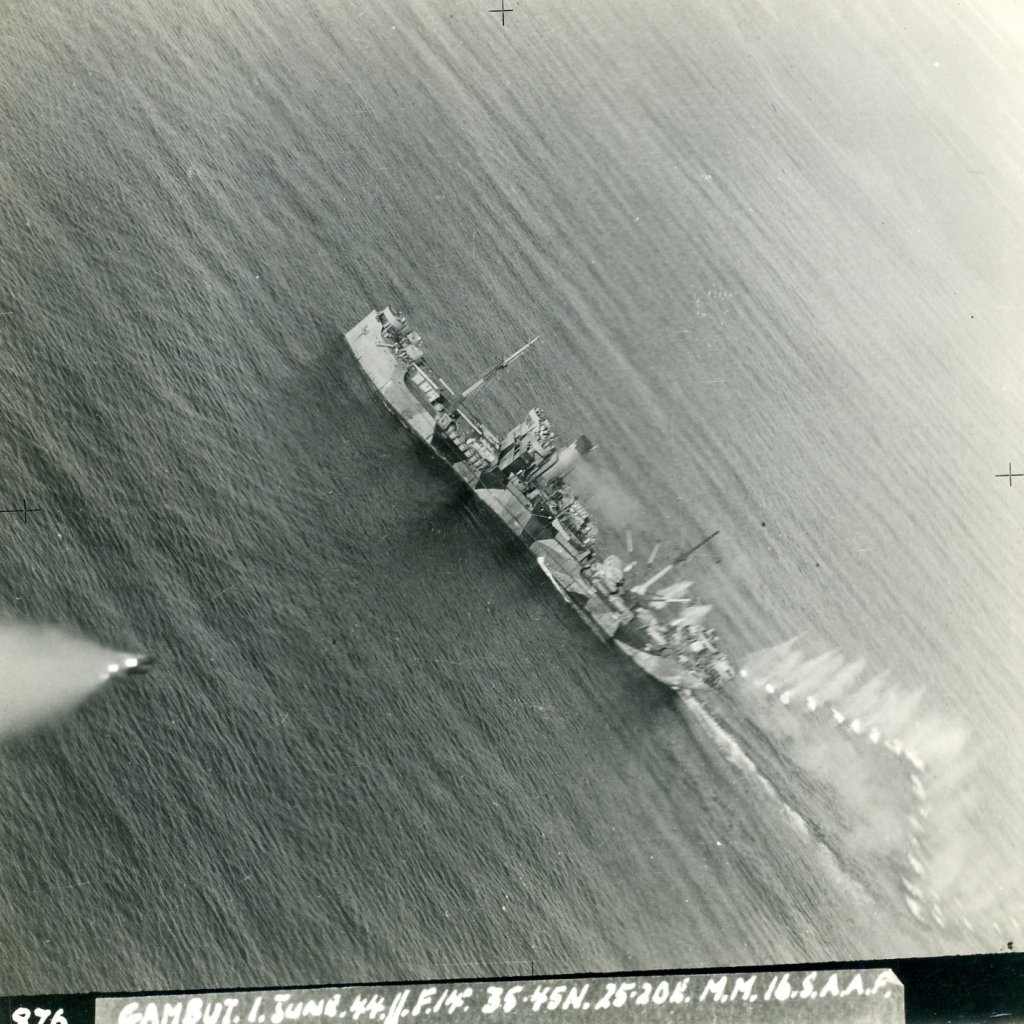

 ww2stories